
Why 94% of AI Agent Projects Fail (And What the 6% Do Differently)
Table of Contents
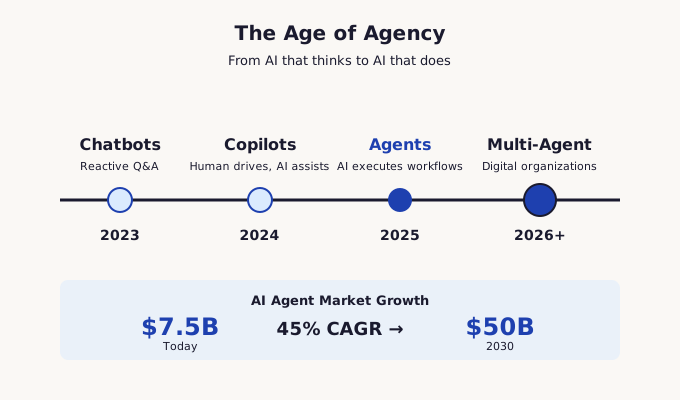
The AI agent market is worth about $7.5 billion today and headed to $50 billion by 2030—a 45% CAGR. But here’s the twist that makes this essential: 62% of companies are experimenting with agents, but only 6% have achieved meaningful results.
That’s a 10-to-1 ratio of experimentation to results. What’s going wrong? And more importantly, what separates the 6% that are winning from the 94% that are burning money?
From Chatbots to Autonomous Systems: The Timeline
In 2023, we were in the chatbot era—you type a question, you get an answer. Call that reactive Q&A. 2024 brought us copilots. Microsoft pretty much owned the word. We had GitHub Copilot, Microsoft 365 Copilot. Humans still in the driver’s seat, but AI riding shotgun.
But 2025 is when the game truly changed. We entered the world of agents—systems that don’t just think, they act. They take action on your behalf. They execute multi-step workflows, call APIs, navigate browsers, and come back with results.
Looking forward to 2026 and beyond, we’re headed toward full multi-agent systems—entire digital organizations of specialized AI workers collaborating with each other.
“These are systems that go off and do something on your behalf with minimal to zero supervision.” — Jared Kaplan, Anthropic
Here’s the key mental model shift: we went from AI that thinks to AI that does. That’s the fundamental change.
What Actually Makes an Agent (Not Just a Fancy Chatbot)
So what separates a real agent from a chatbot? Here are the five pillars:
Complex environment navigation. An agent doesn’t just sit in a text box. It’s using tools, invoking external programs, navigating browsers, IDEs, operating systems. Programs that historically had interfaces designed for humans—the agent can now interact and understand the intent behind those systems.
Multi-source instruction. You can give an agent an ambiguous goal like “prepare a quarterly report.” It will decompose that into concrete executable steps—executive summary, financial figures, data sourced from multiple systems.
Dynamic feedback. When an agent hits an error, it perceives the consequence, retries, and adapts. A chatbot would just hallucinate successfully and move on.
Tool use. Sometimes called function calling. An agent can send an email, deploy code, query a database, transfer funds. Think of an agent as a computer operator with hands, not just a brain.
Persistent memory. The agent maintains a knowledge graph that retains context across multiple sessions and workflows.
The analogy I love: a chatbot is a brain in a jar. An agent is a brain with hands, eyes, and memory.
The Four Levels of Agent Autonomy
Not all agents are the same. Over the last few weeks deploying multi-agent orchestration systems with clients, I’ve developed a four-level rubric for understanding autonomy.
Let’s use a consistent task: “Process this month’s expense reports.”
Level 1: Copilot (Human is Operator) You tell the copilot you need to process 47 expense reports. It scans them and says, “Here are 12 reports with policy violations. Would you like to view them?” You review each one manually and decide. AI suggests, human decides. Safe but slow.
Level 2: Agentic Workflows You say “run the monthly expense processing pipeline.” The agent extracts all reports, validates, categorizes, flags exceptions. It reports back: “35 reports passed all checks, 12 flagged for review, batch ready for sign-off.” Predefined sequence, deterministic, human reviews output before anything proceeds.
Level 3: Semi-Autonomous The agent auto-processes reports and applies company policy. “35 reports approved and submitted automatically. 9 reports had minor variations I auto-resolved—sent reminders for missing receipts. 3 reports require explicit human approval because they exceed the $500 threshold.” The agent handles routine decisions independently, only escalating at policy edge cases.
Level 4: Fully Autonomous The agent triggers the expense cycle on schedule. It processes 47 reports, cross-references travel calendars, product codes, vendor history. It autocorrects miscategorized expenses. It detects an anomaly: “$1,200 hotel charge with no matching receipt, no calendar event, vendor has a fraud flag from last quarter. I’ve blocked this report and reported to compliance.” Updates the dashboard: 98% auto-resolved, one flagged as fraudulent, here’s your processing time.
“In Level 4, the human is the goal setter. The system is fully autonomous—you define the goal, define the guardrails, the agent processes, decides, learns, and surfaces only anomalies.”
The React Pattern: Why LLMs Can Now Do Math
Let’s go under the hood. The React pattern—Reasoning and Acting—is the foundation of modern agent frameworks.
It’s an iterative framework where LLMs interleave reasoning traces with tool actions. Three stages cycle until the goal is reached:
- Thought: Reason about the current state, plan the next step
- Action: Call a tool with precise parameters
- Observe: Process the result, refine understanding
Here’s the problem with LLMs doing math in their heads: I tested Gemma 3 and Llama 3.1 on a simple calculation—15 items at $8 each plus 20 items at $8 each. Without tools, using chain of thought alone, they arrived at 279. The correct answer is 280.
With the React pattern providing calculator tools? All three models arrived at the correct answer.
The harder problem was revealing: “A store sells 847 items at $23.50 each and 1,293 items at $17.85 each. Calculate combined revenue, apply 12.5% bulk discount, add 13% sales tax. What’s the final amount?”
Gemma 3 (4 billion parameters) without tools: $42,229.41. Correct answer: $42,597.
With React tools? The agent thought: “First I need to calculate revenue from 847 items.” It called the multiply tool. Observed the answer. “Now I need revenue from the 20 items.” Called the tool again. “Now I need to add those revenues.” Called the add tool. Step by step, it arrived at the correct answer.
Every model with the React pattern arrived at the right result.
The Frameworks and Protocols Powering the Agent Revolution
If you’re building agents, what tools are available? This is the picks and shovels of the agent gold rush.
Top frameworks by GitHub stars:
- LangGraph: ~100,000 stars. Graph-based state machines for enterprises wanting flexibility with deterministic outcomes.
- Crew AI: ~42,500 stars. Role-playing abstractions—manager agents delegating to worker agents.
- Microsoft Autogen: ~37,000 stars. Combination of Autogen and Semantic Kernel for Azure shops.
- OpenAI, Amazon Bedrock, Google ADK: Python-first, cloud-ecosystem specific.
The key insight: there’s no single winner. Your choice will be driven by your cloud ecosystem, not by hype.
MCP: The USB-C for AI Model Context Protocol from Anthropic—arguably the most important protocol to emerge in the last 18 months. Before USB-C, every phone had a different charger. Before MCP, every agent framework had its own way of connecting to tools. MCP standardizes that.
Since Anthropic released MCP in November 2024, over 30,000 MCP servers have appeared. MCP has become the TCP/IP of the agent era. If you’re building agents and not thinking about MCP, you’re building on quicksand.
A2A: Agent-to-Agent Protocol Introduced by Google in April 2025, now under the Linux Foundation with 150+ partners. If MCP is how agents talk to tools, A2A is how agents talk to each other. Together, they form the backbone of agentic communication.
Why 94% Fail: The Enterprise Reality Check
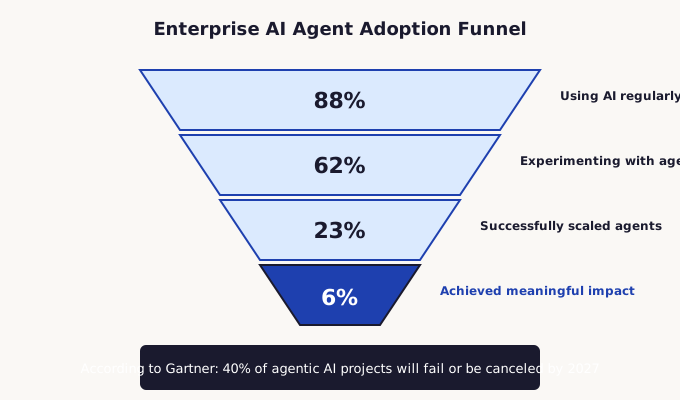
Regular AI use sits around 88%. 62% are experimenting or scaling agents. 52% have deployed at least one agent in production.
But look at the drop: only 23% have successfully scaled agents. And only 6% have achieved meaningful impact.
According to Gartner, 40% of agentic AI projects will either fail or be canceled by 2027.
When agents work, they really work. Companies getting it right achieve positive ROI within the first year—some projecting over 200% ROI in under six months. But those companies had:
- Well-defined business objectives
- Clear operating models
- Clarity on governance
- Audit trails for reproducibility
- Ability to satisfy regulators that agents weren’t making biased decisions
The governance capabilities we’ve always talked about in AI? They’re still true. You need access to data that makes you unique. You need to think about day two—how these agents will be managed. The emerging field of agent ops. You need that layer of governance, that agentic control plane ensuring responsible AI and proper IT architecture.
Standards alone aren’t enough for enterprises. MCP and A2A don’t have built-in authentication—you bring your own. You need role-based access control, PII filtering, audit trails. Many agentic implementations only implement part of the spec. You need a compliance layer on top.
This is why the 6% succeeding have something the 94% don’t: they’re not just building agents, they’re building the infrastructure to govern them.
Want to go deeper on the React pattern and see live demos of LLMs solving complex math problems? Check out the full episode where we walk through Python code showing exactly how Gemma, Llama, and IBM Granite handle multi-step calculations with and without tools.
Related Episodes
Dive deeper into these topics in the podcast.

AI Agents.
The episode explores the rise of AI agents, their evolution from chatbots, and the challenges and opportunities in deploying and scaling AI agents. It delves into the characteristics of AI agents, ...
Enjoying this article?
Ship AI is a video podcast covering the trends, tools, and strategies driving enterprise AI. New episodes every two weeks.