
AI Adoption in Enterprises: The Reality Check
Table of Contents
I’ve been digging into enterprise AI adoption data, and there’s one number that keeps haunting me: 6%.
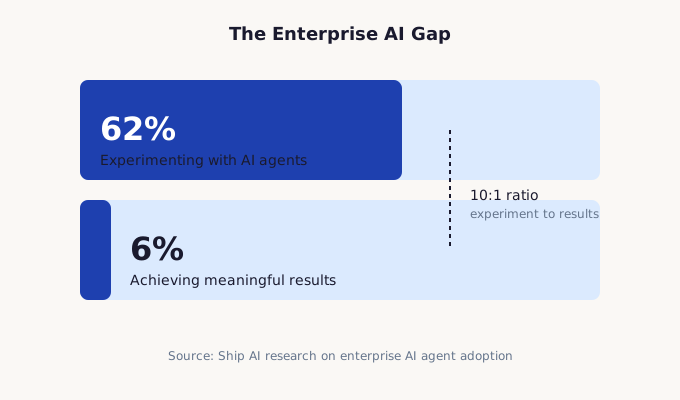
That’s the percentage of companies that have achieved meaningful results with AI agents. Not experimenting. Not piloting. Actually shipping something that moves the needle.
Meanwhile, 62% of companies are actively experimenting with agents. So we’ve got a 10-to-1 ratio of experimentation to results. That’s not an adoption curve — that’s a graveyard of failed pilots.
The Great Mismatch
Here’s what’s happening. The AI agent market is worth about $7.5 billion today, headed to $50 billion by 2030. That’s a 45% CAGR. Money is absolutely flooding into this space.
But when I look at where that money actually goes, it’s mostly going into experimentation budgets. Proof of concepts. Demo environments. “Let’s see what this can do” projects that never make it to production.
“62% of companies are experimenting with agents, but only 6% have achieved meaningful results. That is a 10 to 1 ratio of experimentation to results.”
The gap between “playing with AI” and “shipping AI” is enormous. And it’s not getting smaller — it’s getting wider as more companies pile into experimentation without a clear path to production.
What Separates the 6%?
I’ve been studying what the winning companies do differently, and it comes down to a mental model shift.
Most companies are still treating agents like chatbots with extra steps. They ask: “How can we make our chatbot smarter?” Wrong question.
The 6% ask: “What workflows currently require a human to navigate systems, make decisions, and take actions — and how do we hand those off entirely?”
That’s a different question. It leads to different architecture decisions, different success metrics, and different organizational buy-in.
The key insight from studying successful deployments: agents aren’t brains in jars. They’re brains with hands, eyes, and memory. The companies that win are the ones that give their agents actual work to do — not just questions to answer.
The Autonomy Trap
One pattern I see in the 94% that are struggling: they’re building agents at the wrong autonomy level.
They either go too conservative (basically building a slightly smarter chatbot that still needs human approval for everything) or too aggressive (trying to build fully autonomous systems before they’ve proven value at simpler levels).
The 6% take a staged approach. They start with what I call “agentic workflows” — predefined pipelines where the agent runs a fixed sequence but humans still review output. Once that works, they add approval gates. Then semi-autonomous work. Then full autonomy.
Each level builds trust. Each level proves ROI. Each level surfaces the edge cases you need to handle before moving to the next.
“A chatbot is a brain in a jar. An agent is a brain that has hands, eyes and memory. Huge difference.”
The companies burning money are the ones trying to skip levels. They want to go from chatbot to fully autonomous agent in one leap. It doesn’t work. You end up with something that’s too smart to be a chatbot and not reliable enough to be trusted with real work.
Where This Goes
I’m watching the 6% closely because they’re writing the playbook everyone else will follow. The gap won’t stay this wide forever — but right now, there’s a massive first-mover advantage for companies that figure out how to cross the experimentation-to-production chasm.
If you want the full breakdown on agent architecture, autonomy levels, and what the winning deployments look like in practice, check out the complete episode on the age of agency. We go deep on the four-level autonomy spectrum and the specific patterns that separate production systems from perpetual pilots.
Related Episodes
Dive deeper into these topics in the podcast.

AI Agents.
The episode explores the rise of AI agents, their evolution from chatbots, and the challenges and opportunities in deploying and scaling AI agents. It delves into the characteristics of AI agents, ...
Enjoying this article?
Ship AI is a video podcast covering the trends, tools, and strategies driving enterprise AI. New episodes every two weeks.