How a Bank Chief Architect Thinks About AI Agents and Non-Deterministic Systems
Table of Contents
“It’s difficult enough to work with a single non-deterministic solution. It’s another thing to expect that multiple non-deterministic entities communicate among themselves and would generate a somewhat predictable outcome.”
That’s Lawrence Wan, Chief Architect and Innovation Officer at Bank of Montreal, one of Canada’s largest financial institutions. He’s spent decades building large-scale distributed systems in financial services, and his perspective on AI adoption cuts through the hype with the kind of measured pragmatism you’d expect from someone responsible for systems that millions of people depend on daily.
Technology as Foundational Business Capability
Banking is fundamentally a relationship business built on trust. But delivering on that trust at scale requires technology to be woven into the fabric of operations—not treated as a cost center or afterthought.
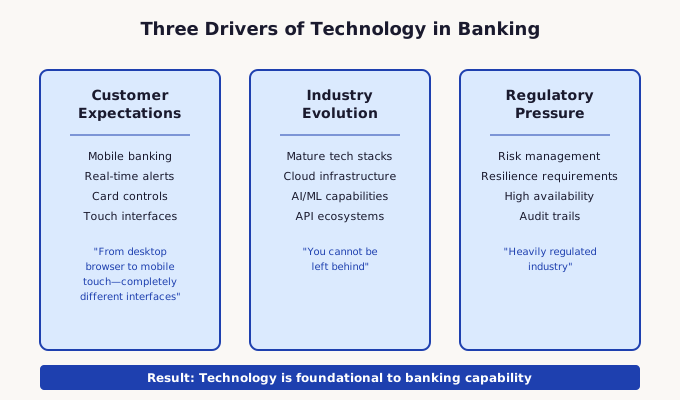
Lawrence sees three drivers pushing this reality:
“Customer expectations—customers are very comfortable dealing with technologies for any other product and services they acquire in their daily life. So it’s just a matter of time that they will also expect financial product services to be delivered through technology as well.”
The second driver is industry evolution itself. Technology has matured to be applicable across banking in ways it wasn’t even a decade ago. And third, regulatory pressure demands it. Risk management, resilience, availability—none of these can be addressed without technology being part of the equation.
“It’s no longer possible to distribute and fulfill product and services without the help of technology,” Lawrence says.
Designing Systems That Last (And Can Still Change)
How do you build systems that serve millions of customers while keeping pace with rapidly changing expectations? Lawrence’s approach divides capabilities into distinct layers.
“We typically look at systems of experience, system of interactions—whether it’s external customer facing or employee facing systems—versus the concept of a system of records.”
The transaction systems maintaining accounting and financial balances change less frequently. But the systems customers interact with? Those evolve constantly. Not long ago, internet banking meant clicking through a browser on your desktop. Now it’s all touch-based mobile interfaces with features like instant card controls and real-time alerts.
“A lot of this functionality needs to continue to evolve as customers expect a different experience,” Lawrence explains. “We always look at an environment to identify things that we need to continuously evolve very quickly per demand, and things that fundamentally at their core are more consistent, less susceptible to changes.”
Where AI Actually Delivers Value Today
Before diving into generative AI, Lawrence makes an important distinction about how BMO views AI adoption. They look at it through three components: the data (quality, representation, readiness), the business process (individual tasks and end-to-end flows), and then the algorithms—whether rule-based, machine learning classification, or generative AI.
“We’ve been in the business for quite some time, knowing how to process data and understand our business process. There’s quite a few opportunities for us to use very specific machine learning and deep learning models to address very specific tasks—usually classification exercises, very specific prediction exercises.”
Those capabilities are already mature within the organization. For generative AI, the bank is applying it heavily to the software development lifecycle. Requirements gathering is one area where they’ve seen real impact:
“A lot of the requirements are typically through discussion within a meeting. You can summarize the meeting through ongoing discussions and through documentation by creating Word documents with different structure and tables. Using AI to help create those artifacts is quite efficient.”
Code generation shows “varying degrees of success” depending on the workload and the developer’s experience. But here’s the real insight: learning how to prompt correctly and provide enough context makes a difference of more than 10% in productivity alone.
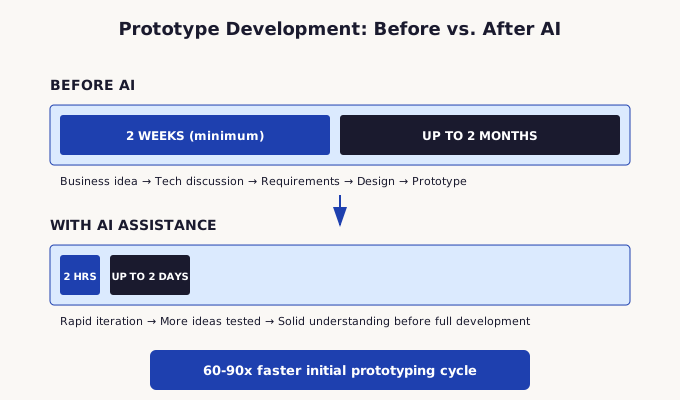
The most striking change? The feedback loop between business and technology has compressed dramatically.
“It used to be the business to technology interactions are much longer before. Typically, it takes two weeks to two months to come up with a prototype. Now the cycle becomes two hours to two days.”
The Agent Problem: Non-Deterministic Orchestration
When it comes to AI agents, Lawrence takes a notably conservative stance—and his reasoning reveals the core challenge facing regulated industries.
“We are trying to go very conservatively only because it’s difficult enough to work with a single non-deterministic solution. It’s another thing to expect that multiple non-deterministic entities communicate among themselves and would generate a somewhat predictable outcome.”
The monitoring and validation frameworks simply aren’t mature enough yet for a fully agentic world in banking. But Lawrence doesn’t think that world is far away—maybe two to three years, possibly shorter.
His advice for anyone designing agents: think carefully about bounded contexts.
“It’s important to define agents that doesn’t have overlap functions. Because if you’re trying to dynamically identify which is the appropriate agent for payment, for example, there’s at least three to four different types of electronic payments. You don’t want to design four agents with overlapping capabilities and then not know which one to pick.”
The parallel to microservices design isn’t accidental. The same architectural discipline that made distributed systems manageable will matter even more when those services become autonomous agents.
What This Means for Careers in Tech
Is coding dead? Lawrence thinks that’s “probably a little bit too extreme.”
“Knowing a specific programming language in detail is probably less of a differentiation. But it’s more important to understand the design construct. It’s more important to have critical thinking. It’s more important to be able to problem solve.”
The skills that matter: differentiating evidence-based data from unreliable sources, understanding systems from silicon up to runtime, and—critically—being able to continue learning. Lawrence’s own background in chip design gives him perspective on why understanding the full stack still matters, even as individual coding tasks get automated.
On the question of AI taking all jobs, he’s optimistic: “We have enough time to continue to adjust like all the other technology revolutions.”
The opportunity he sees? Use AI-driven productivity gains not just to cut costs, but to free up capacity for truly differentiating work. Someone has to use that extra capacity to create products and services that matter.
For more perspectives on building enterprise AI systems, check out our episodes on AI infrastructure scaling and regulatory considerations in financial services.
Related Episodes
Dive deeper into these topics in the podcast.
Lawrence Wan, Chief Architect, BMO
Lawrence Wan, Chief Architect and Innovation Officer at BMO, shares insights on technology transformation, AI adoption, and the future of agentic systems in banking.
Enjoying this article?
Ship AI is a video podcast covering the trends, tools, and strategies driving enterprise AI. New episodes every two weeks.