Physical AI: The $50 Trillion Market Nobody's Talking About
Table of Contents
In 1920, Czech playwright Karel Čapek introduced the word “robot” to the world in his play Rossum’s Universal Robots. The word comes from the Czech robota, meaning repetitive tasks or drudgery. A century later, robots are no longer doing just drudgery—they’re getting intelligent.
We’ve spent years following the AI money, understanding why everything feels so sudden, tracking the geopolitics. This episode is about something different: the paradigm shift. What happens when AI goes from screens to streets, from chatbots to robots?
The Robots Aren’t Coming—They’re Already Here
Look at any recent NVIDIA presentation and count the humanoid robots. These aren’t concept renders. They’re shipping products or active prototypes. There’s even a prototype that Boston Dynamics has already retired. NVIDIA wants you to understand that we’ve crossed the threshold.
For the last two to three years, the world has been obsessed with large language models. Let’s call that AI behind screens. That era isn’t ending, but it’s been joined by something far bigger. AI is about to get a body. And when AI gets a body, everything changes. Markets become 100 times bigger. Technical challenges are different. Workforce implications are on a whole different level.
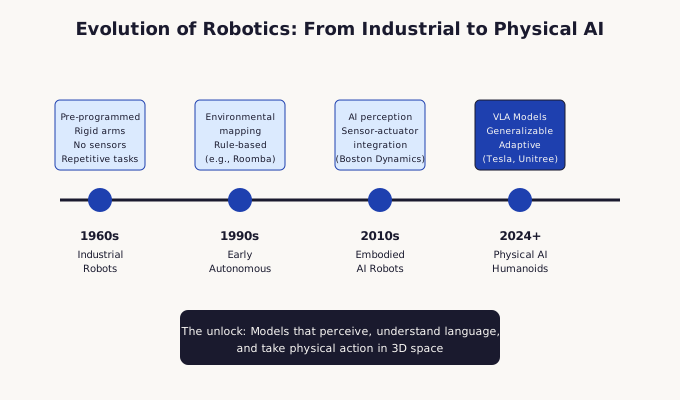
Here’s the high-level formula: For decades, we’ve had digital technology and, separately, automation—crude robots doing repetitive tasks. What’s new is the combination. Add AI to physical systems and you get something qualitatively different.
Take a car, add AI—you get an autonomous vehicle. Could be a car, truck, or taxi. Take a warehouse worker, add AI, give it a form factor so it can park cars, move packages, work logistics. You get an industrial robot. Take the human form, replicate it into a quadruped or biped, add sensors and rotary actuators, add a model that perceives and understands commands in human language—you get a humanoid robot. That’s the unlock.
The $50 Trillion Opportunity
Let that sink in. $50 trillion. According to analysts from Morgan Stanley to Goldman Sachs to F-Prime, the bear case is about $9 trillion. The bull case goes as high as $50 trillion.
For context, the global software market today is approximately $600 billion. That includes all of digital AI, all of the chatbots. Copilots are a fraction of that—maybe $50 billion at the high end. Physical AI is going to be 100 times larger.
“This is why Apple builds robots. This is why Meta is building glasses. This is why Tesla calls itself an AI company. This is why Amazon has a million warehouse robots.”
If you’re a $3 trillion company and you want to grow, you don’t chase $50 billion markets. You chase $10 trillion markets. You chase $50 trillion.
The ChatGPT moment for physical AI is here. Waymo is delivering 150,000 paid rides per week, fully automated. Tesla has over 11 million vehicles collecting data. Amazon has over a million warehouse robots. We’re already seeing over 13,000 humanoid robots shipped globally in 2025 alone, a large majority in China.
This isn’t about whether AI is going to transform industry. It’s about how fast and who leads.
Quick math: Cost of labor in the developed world runs $25-30 per hour. Operating cost for a humanoid is somewhere between $2 and $10. China installed over 450,000 industrial robots last year—more than the rest of the world combined. Take the dollar value impact for all human labor this technology can replace, and that’s how you get to $50 trillion.
Vision-Language-Action: The New Foundation Models
The race for large language models continues, but the frontier has moved. There’s a new race emerging for vision-language-action models—VLAs. These are AI systems that see the world through vision models, understand instructions in language, and take physical actions.
These models are fundamentally harder than LLMs. Language models predict the next token. VLA models predict the next movement and execute it in 3D with physics involved, plus the consequences of that action. Whoever solves this problem will own the next decade in AI.
We’re seeing a Cambrian explosion. Just like 500 million years ago, every niche is being filled simultaneously. Quadrupeds, humanoids, snakes, swimmers, drones, warehouse robots, surgical arms, agricultural machines—every form factor is being explored. This is evolution fast-forwarded by AI instead of natural selection.
The world models behind these systems are what separate robots that can only do what they’re programmed for from robots that can reason about new situations. That’s the difference between automation and intelligence.
“The robot looks at an apple on a table and goes through a reasoning loop: I have never seen this apple on this table, but I understand apple. I understand table. I understand gravity. I can figure this out.”
Key players include Yann LeCun’s work at Meta (he calls world models the path to true AI), NVIDIA’s Cosmos foundation model, and Google’s Genie and Dreamer systems.
China’s Humanoid Revolution
This is where the rubber hits the road. Let me introduce the Chinese humanoid players that are actually deploying—not just demoing—these robots.
Unitree’s G1 is available for $16,000. This is the most deployed humanoid in the world today. Not the most capable, but the most accessible. They’re following the Chinese playbook: go to market, iterate fast, win on volume.
Ubtech’s Walker S is already working in car factories. Not pilots—production. They’re doing seat belt inspection, testing door locks, applying labels. Real work, real factories.
Fourier’s GR1 focuses on healthcare, designed to carry 50 kilograms for what they call the “silver economy.” With China’s fertility rate at 1.02—one of the lowest in the world—they’re betting humanoids will solve the elder care crisis.
President Xi Jinping personally visited AGI Bot’s facility in April 2024. When the head of state visits a robotics startup, that’s a signal. This is state priority.
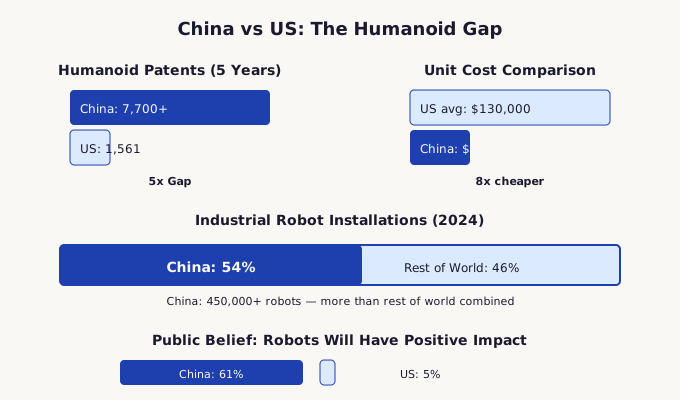
Why is China winning? Manufacturing DNA—they have three times the US industrial base. Cost advantage—$16,000 versus $130,000 starting price for US humanoids. Massive talent pipeline. And crucially, 61% of Chinese citizens believe robots will have a positive impact on society versus only 5% in the US.
This public acceptance isn’t happening by chance. They’ve been deliberate. National broadcasts of humanoid boxing competitions. Dance performances. Half-marathons. Every major automaker from BYD to Geely has humanoids on factory floors. There’s a government mandate: humanoid industry must mature by 2027.
We’ve seen this movie before with solar panels. Bell Labs invented the technology in New Jersey in 1954. By 2023, nearly 100% of solar panel manufacturing happens in China. The global humanoid race may follow the same trajectory.
Autonomous Vehicles: The Most Mature Category
This is the most mature category of physical AI—real revenue, real data, and some real cautionary tales.
Waymo is the clear leader. Over 150,000 weekly paid rides, by some reports as many as 450,000. This is not a pilot anymore. This is a business. 90% fewer crashes than human drivers. Valuation somewhere between $45 and $100 billion. Expanded from five cities to 17 by 2026. Partnerships with Uber and DoorDash. Waymo has proven autonomous vehicles work at scale.
Tesla is the wild card. More FSD miles than anyone else. V12 is their breakthrough—end-to-end neural net, finally moving away from rules-based code. About 135 robot taxis in Austin. They’re betting everything on vision only, no lidar. Controversial, but if it works, their cost advantage becomes insurmountable.
Aurora is the emerging B2B player. Over 100,000 driverless miles with zero incidents. Dallas-Houston corridor, 100% on time. FedEx and Uber Freight are customers. Smart pivot—trucking is easier than robot taxis. Highways are simpler than city streets. B2B customers are more forgiving.
Amazon’s Zoox is a $1.3 billion acquisition, purpose-built bi-directional pod with no steering wheel. This brings us to a post-driving world.
The cautionary tale: Cruise from GM. Over $10 billion in cumulative losses. October 2023, they dragged a pedestrian. December 2024, GM exited robot taxis entirely. Things go wrong. Even well-funded efforts fail.
In China, Baidu’s Apollo leads with 17 million cumulative rides, 250,000 driverless rides per week. It’s the first profitable robotaxi operation anywhere in the world. Their RT6 model costs 60% less than competitors at about $28,000. The Chinese manufacturing advantage in action.
This is just the beginning of the physical AI story. In upcoming episodes, we’ll dive into defense applications—the autonomous arms race—and explore how the robotics supply chain is reshaping geopolitics. When your robot’s actuators come from Japan, rare earth magnets from China, and software from the US, supply chain complexity becomes supply chain risk.
Related Episodes
Dive deeper into these topics in the podcast.

What's Next
Physical AI, autonomous systems, and where the technology is heading.
Enjoying this article?
Ship AI is a video podcast covering the trends, tools, and strategies driving enterprise AI. New episodes every two weeks.