AI Job Postings Up 448% While Traditional Tech Jobs Shrink
Table of Contents
New AI-related job postings are up 448% over the past seven years, while non-AI tech jobs have shrunk by as much as 10%. The competition isn’t between humans and AI anymore—that ship has sailed. The competition is between people who use AI and people who don’t.
Over the last few years, we kept hearing how AI will eventually change how we work. It will eventually disrupt jobs. It will eventually force adaptation. But the data says something tremendously different. This is no longer a future tense problem. It’s a present tense divide.
CEOs are no longer running experiments. They’re rewriting performance reviews, headcount approvals, and hiring criteria around one assumption: AI fluency. Jobs aren’t disappearing en masse. What’s disappearing is neutrality. The middle ground between “I’ll wait and see” and “I use it every single day” has completely vanished.
The Reasoning Cost Collapse
The reasoning capability of frontier AI models is deflating faster than Moore’s law. Looking at the decline in inferencing costs for reasoning tasks, the cost has dropped by 1000x in just two and a half years.
To put this in perspective: the concept that something other than a human could reason—and be made available at scale to billions of people globally—was either fantasy or available only to researchers. In a short two and a half years, not only has that capability arrived, but it has been diffused to every LLM user on the planet.
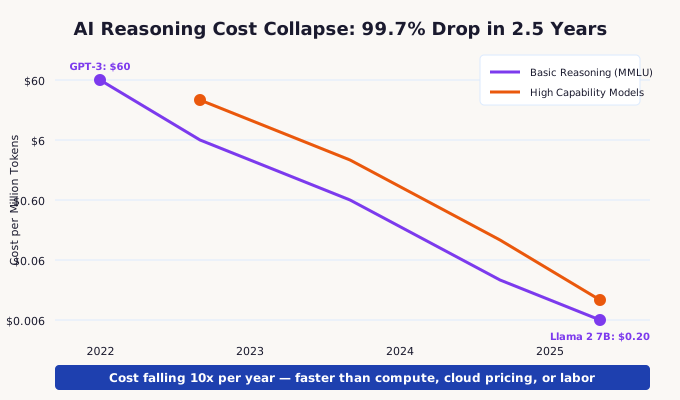
Starting with GPT-3, reasoning capability was introduced at $60 per million tokens. By 2024, it dropped to about 20 cents with Llama 2 7B. That’s not an optimization—that’s a structural collapse. Each new generation resets the curve downward.
“When intelligence costs pennies, using it is no longer a choice. Not using it becomes an anomaly.”
This is the quiet engine behind everything else: the polarization of jobs, wage premiums for AI researchers, burnout among knowledge workers trying to keep up, and the disappearance of neutrality.
The Jevons Paradox Applied to AI
In mid-19th century Britain, economists worried that declining coal reserves threatened economic vitality. A consensus emerged that more efficient steam engines would reduce coal consumption. Until William Stanley Jevons argued the opposite: improvements in efficiency would actually increase demand for coal. History proved Jevons right.
We’ve seen this pattern repeat with refrigerators, the internet, and now AI. When technology becomes more efficient, we don’t use less—we use more. As models become cheaper and more capable, lower costs make them accessible to more users, which drives exponential growth in total consumption.
The employment data confirms this pattern. AI job postings are up 448% over seven years. The AI intensity is highest in knowledge work sectors: information technology, professional and scientific services, finance and insurance. In these sectors, practically all work is knowledge work, and the greater the knowledge work, the greater the opportunity to implement AI.
This isn’t isolated data. ZoomInfo tracked a 200% increase in AI-titled job postings over three years. Nearly 90% of jobs in professional, scientific, information, manufacturing, finance, and retail industries now have AI job concentration.
CEO Mandates: No Longer Asking, Now Requiring
CEOs are no longer asking employees to experiment with AI. They’re altering the fundamental assumptions of employment.
Toby Lutke, CEO of Shopify, issued six mandates in April 2025. AI proficiency is non-negotiable. AI should be part of prototyping. Performance reviews now include AI usage. His quote: “If you’re not climbing, you’re sliding.”
Luis von Ahn, CEO of Duolingo, announced they would start phasing out contractors using AI. Humans become auditors of machines. New headcount will only be approved if teams can prove AI can no longer do the work. AI is now used in hiring and performance reviews.
There was pushback on social media. But revenue projections increased to over a billion dollars. No full-time layoffs occurred, but contractors are being phased out. If you thought your job was safe as a contractor, AI is coming for you.
Klarna provides a cautionary tale. In February 2024, they claimed an AI chatbot could do the work of 700 full-time agents, projecting $40 million in savings. The chatbot could resolve problems five and a half times faster than humans. They’ve since started hiring humans again due to challenges—but the bottom line is that CEOs are believing in AI’s value for their top and bottom lines, despite issues still being resolved.
“You’re not going to lose your job to an AI, but you’re going to lose a job to someone who uses AI.” — Jensen Huang
The 92% Adoption, 1% Maturity Gap
McKinsey’s “Super Agency in the Workplace” report found 92% of companies are investing in AI. But here’s the interesting part: the percentage of companies at AI maturity was only 1%.
Nearly half of C-suite executives complain that AI deployment is too slow. 92% plan to increase AI investment in the next three years. But employees are actually three times more ready than leaders think. McKinsey found 13% of employees use AI daily, while leaders estimate only 4%. And 47% of employees expect their AI usage to increase by 30% or more within a year.
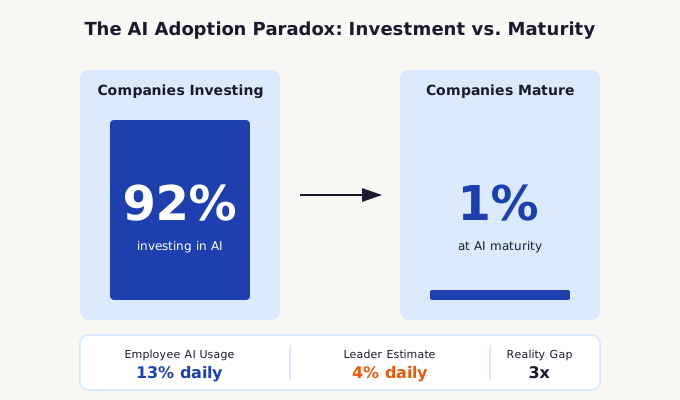
CEOs want AI used faster. Employees are using AI more than leaders realize. This misalignment is ripe for problems—and the Stanford Digital Economy Lab confirms it: as many as 80% of AI pilots deliver little to no P&L impact.
The projects that succeed fall into what I call the “green light zone”—high desire from employees combined with high capability from the technology. That’s data reporting, quality control, retrieval-augmented generation, talking to documents. Projects outside this zone—where either workers don’t want it or the technology can’t deliver—fail consistently.
Workers want partnership, not replacement. Organizations with equal partnership are where AI implementations succeed. As of today, workers want AI as a collaborator: 69% are willing to be equal partners when AI frees up time for high-value work.
The Two Job Markets: Premium vs. Depreciation
AI skills are commanding premiums. PWC’s Global AI Jobs Barometer analyzed approximately one billion job ads. AI skill implemented into a job provides a boost of as much as $18,000 a year. But the biggest premium goes to those with AI skills plus soft skills—the ability to communicate and apply judgment alongside the technology.
There’s also skill depreciation happening. Systems administrators, SQL developers, senior software engineers—these once high-demand jobs that commanded high wages are now seeing significant depreciation. Meanwhile, mid-level AI engineers, machine learning engineers, and a whole new category of LLM developers are appreciating.
For the first time in history, there’s risk being introduced to the computer science degree. The tech job as a monolithic safe category is dead. Technology skills alone are being commoditized.
The Productivity Reality Check
Randomized controlled trials from Microsoft, GitHub, Stanford, and MIT show productivity gains for certain tasks. A Stanford-MIT study of 5,000 developers found an average productivity gain of 26%. Junior developers gained 35-40%. But for senior developers, the gain was only 8-16%—and in some cases, seniors actually lost productivity.
The gains are real but not uniform. They favor junior, routine work. And as anyone who has written code at scale knows: writing code is only about 20-30% of a developer’s job. Who cares if you can write code 50 times faster if the code is slop and you can’t debug it?
Here’s the uncomfortable finding: 70% of full-time AI users report burnout. It’s great that I can use Claude Code or Codex or DeepSeek to generate code. But I still have to integrate that code into my existing pipeline, run tests, understand how it behaves with the ecosystem, log and monitor it. All those additional tasks still require cognitive load.
52% of workers are worried about AI. 36% are hopeful. The fear is uniform across the board that AI will make them replaceable. The actual reality is less than 15% of users are actually using AI daily.
The Choice Already Made For You
You have two options. Option one: learn AI now and potentially gain as much as a 56% premium in your job, get a productivity multiplier, achieve some career security.
Option two: choose to ignore AI. You become part of the shrinking job market with skills depreciation. You’ll be on the wrong side of CEO mandates, facing career disruption.
If you’re not using AI, here’s a five-day plan to go from zero to AI-integrated:
Monday: Audit your tasks. List your top 10 weekly tasks, mark which could use AI assistance, find one high-frequency, low-stakes task AI can do.
Tuesday: Set it up. Most tools are free.
Wednesday: Learn and implement it.
Thursday: Reflect. What worked, what didn’t?
Friday: Add other tasks to your workflow. Document your progress, share results with a colleague.
AI didn’t arrive like a wave that wiped out jobs overnight. It arrived like gravity—quietly, constantly, impossible to escape. Gravity doesn’t care where we live. It only cares whether we’ve adapted our footing.
For more on how AI is reshaping specific industries, check out our episodes on physical AI’s $50 trillion opportunity and the infrastructure challenges facing AI’s expansion.
Related Episodes
Dive deeper into these topics in the podcast.
AI At Work
The conversation explores the impact of AI adoption on the labor market, job tasks, disruption, and fluency.
Enjoying this article?
Ship AI is a video podcast covering the trends, tools, and strategies driving enterprise AI. New episodes every two weeks.