
AI's Rapid Reasoning Cost Drop: A Game Changer
Table of Contents
When I first looked at the cost data for AI reasoning models, I had to double-check the numbers. They seemed wrong.
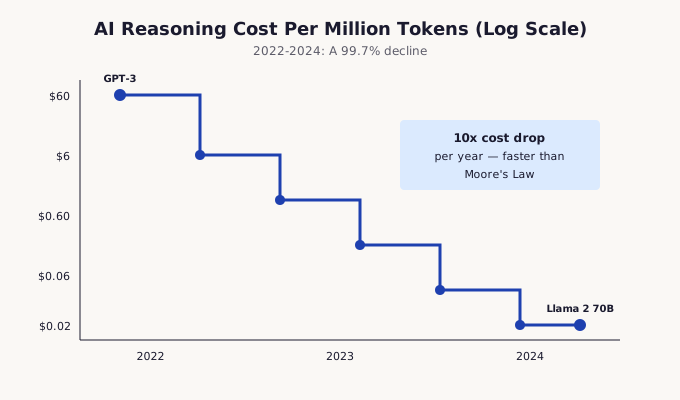
In two and a half years, the cost of reasoning-capable AI has dropped by over 99%. Not gradually. In sharp, sudden cliffs.
The numbers that changed my thinking
Here’s what the a16z data actually shows: GPT-3 introduced reasoning capability at $60 per million tokens. By 2024, you could get equivalent capability from Llama 2 70B for about 20 cents.
That’s not optimization. That’s structural collapse.
“When intelligence costs pennies, using it is no longer a choice. Not using it becomes an anomaly.”
The pattern repeats across both basic reasoning models (those hitting standard benchmarks) and high-capability models approaching human-level reasoning scores. Each new generation doesn’t just improve—it resets the entire cost curve downward.
We’re seeing costs fall by roughly 10x per year. Faster than compute improvements. Faster than cloud pricing drops. Faster than any labor cost reduction in history.
Why this matters more than any AI benchmark
This cost collapse is what’s driving everything else we’re seeing in the labor market. The 448% increase in AI job postings. The 9% shrinkage in non-AI tech roles. The polarization between people who use AI daily and those who don’t.
When I discussed this on the podcast, I brought up the Jevons paradox—the 19th century observation that when steam engines became more efficient, coal consumption actually increased. Everyone expected efficiency gains would reduce demand. The opposite happened.
We’re watching the same pattern unfold with AI. Reasoning capability that was fantasy-level expensive two years ago is now available to anyone with an internet connection. And because it’s cheap, usage is exploding.
“What this chart tells you is it’s the quiet engine behind polarization around everything else—jobs, wage premiums for AI researchers, burnout with knowledge workers trying to keep up.”
This is why I keep saying the middle ground has disappeared. When intelligence costs almost nothing, the question isn’t whether AI will change your job. It’s whether you’ve already adapted or you’re falling behind people who have.
The uncomfortable part? This cost curve isn’t flattening. Every new model generation resets it downward again.
This is from Episode 4 of Ship AI, where I dig into how cheap intelligence has rewired the labor market and why the productivity gains aren’t showing up in paychecks. Listen to the full episode.
Related Episodes
Dive deeper into these topics in the podcast.

AI At Work
The conversation explores the impact of AI adoption on the labor market, job tasks, disruption, and fluency.
Enjoying this article?
Ship AI is a video podcast covering the trends, tools, and strategies driving enterprise AI. New episodes every two weeks.