AI Job Growth & Industry Impact
Table of Contents
The 448% Signal: Why AI Jobs Are Exploding While Traditional Tech Shrinks
I’ve been staring at this chart from the US Census Bureau data, and the number that keeps jumping out at me is 448%. That’s how much AI-related job postings have grown over seven years in the US market. Meanwhile, traditional non-AI tech jobs? Down 9%.
This isn’t a gradual shift. It’s a structural break in how the labor market values different types of work.
The Arbitrage Is Too Large to Ignore
Here’s what’s driving this: the cost of AI reasoning has collapsed by 1000x in just two and a half years. When GPT-3 first introduced reasoning capability, it cost $60 per million tokens. By 2024, you could get similar capability from Llama 2 70B for about 20 cents.
That’s not optimization. That’s structural collapse.
“When intelligence costs pennies, using it is no longer a choice. Not using it becomes an anomaly.”
I keep thinking about the Jevons paradox here. In the 1800s, everyone assumed that more efficient steam engines would mean less coal consumption. William Stanley Jevons argued the opposite — efficiency would drive adoption, which would increase total consumption. History proved him right. We saw it with refrigerators, with the internet, and now with AI.
As these models get cheaper and more capable, more people use them, which creates more demand for people who know how to build and deploy them. Hence the 448% growth in AI job postings.
Where the Intensity Is Highest
The data from ZoomInfo shows a 200% increase in AI-related job titles over just three years. But what’s more interesting is where this intensity concentrates.
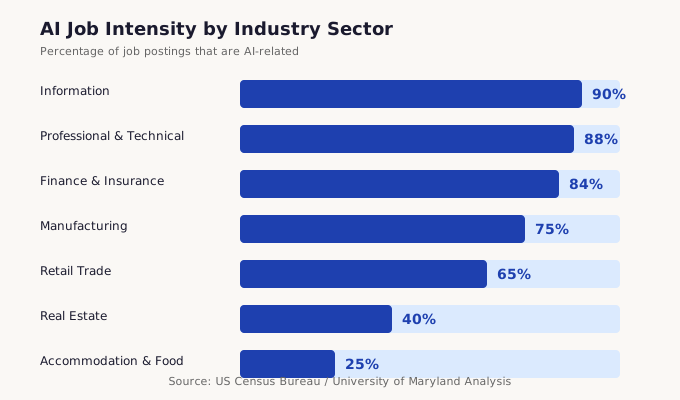
Industries where practically all work is knowledge work — information, professional services, finance — show the highest AI job intensity. Nearly 90% of job postings in these sectors have some AI component. If you’re working in these fields and not using AI, you’re already operating at a disadvantage.
The industries with lower intensity? Accommodation, food services, public administration. Work that still requires physical presence and human interaction. But even those are creeping up.
The Disappearance of Neutrality
What struck me most from digging into this data is that the middle ground has vanished. The gap between “I’ll wait and see” and “I use it every single day” has collapsed.
“You are not competing with AI. That ship has already sailed. You are, however, competing with people who use AI.”
CEOs aren’t running experiments anymore. They’re rewriting performance reviews, headcount approvals, and hiring criteria around one assumption: AI fluency. The uncomfortable truth is that jobs aren’t disappearing en masse — but neutrality is.
The real risk in 2026 isn’t being replaced by AI. It’s being outpaced by those who actually use it.
This insight comes from Episode 4 of Ship AI, where I dig into the full picture of how cheap intelligence is rewiring the labor market. Listen to the full episode here.
Related Episodes
Dive deeper into these topics in the podcast.

AI At Work
The conversation explores the impact of AI adoption on the labor market, job tasks, disruption, and fluency.
Enjoying this article?
Ship AI is a video podcast covering the trends, tools, and strategies driving enterprise AI. New episodes every two weeks.