
AI Adoption: The Maturity Gap
Table of Contents
I’ve been digging into the enterprise AI adoption data, and there’s a gap that nobody’s talking about. Everyone assumes the split is between companies using AI and companies not using AI. That’s not where the divide is happening.
The real divide? It’s between organizations that have moved past experimentation and those still running pilots three years in.
The 92% that haven’t crossed the threshold
Here’s the number that stopped me cold: only 8% of organizations have achieved what researchers call “mature” AI adoption. That means 92% are still somewhere between “we’re exploring this” and “we have a few tools deployed.”
Think about what that means. We’re not early anymore. GPT-3 shipped in 2020. ChatGPT hit 100 million users faster than any product in history. Reasoning costs have collapsed 1000x in two and a half years. And still—92% of organizations haven’t figured out how to operationalize AI at scale.
“The middle ground between ‘I’ll wait and see’ to ‘I use it every single day’ has completely disappeared.”
This isn’t a technology problem. The technology is there, it’s accessible, and it’s cheap. This is an organizational problem. It’s a leadership problem. It’s a “we don’t know how to change how we work” problem.
Where the maturity actually shows up
The data from ZoomInfo and US Census Bureau research paints a specific picture. AI job postings are up 448% over seven years while non-AI tech jobs shrank 9%. But here’s what’s interesting—the concentration isn’t random.
Look at where AI intensity is highest: information, professional services, scientific and technical services, finance, insurance. These are knowledge work sectors. The greater the knowledge work, the greater the AI implementation opportunity.
And within those sectors, the gap between mature adopters and everyone else is widening fast. The 8% who’ve crossed the maturity threshold aren’t just using AI—they’re rebuilding workflows around it. They’re changing hiring criteria. They’re rewriting performance reviews.
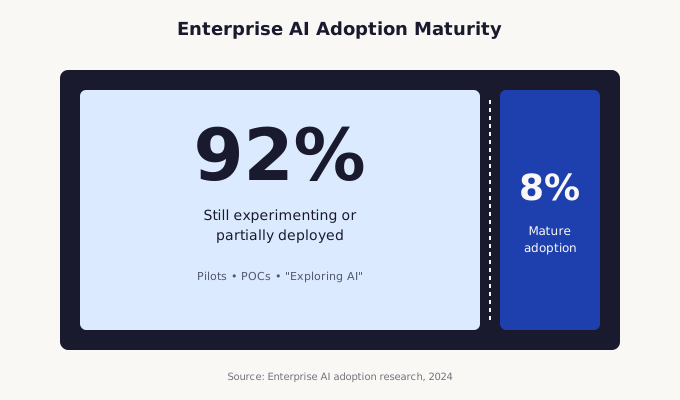
The 92% in the “experimenting” zone aren’t standing still—they’re falling behind. Every month that passes, the mature 8% compound their advantage while the rest run another pilot that goes nowhere.
Why neutrality is no longer an option
I used to think the AI adoption question was binary: use it or don’t. But the data shows something different. The question isn’t whether you’re using AI. It’s whether your organization has reached the maturity threshold where AI actually changes how work gets done.
“Jobs aren’t disappearing en masse. What’s disappearing is neutrality.”
You can’t wait this out. When reasoning costs drop 10x per year—faster than compute, faster than cloud pricing, faster than labor costs—the economics force a decision. Not using AI when intelligence costs pennies isn’t a strategic choice. It’s an anomaly.
The Jevons paradox applies here too. As AI gets cheaper and more efficient, we don’t use less of it. We use dramatically more. And the organizations that figured out how to absorb that usage into their actual operations—not just their innovation labs—are pulling away from everyone else.
If you’re in the 92%, the question isn’t “should we adopt AI?” You already know the answer. The question is: what’s actually stopping you from crossing the maturity threshold? Because I promise you—it’s not the technology.
This clip is from Episode 4: AI At Work, where I break down the full picture of how AI is reshaping the labor market, wage premiums, and what the productivity data actually shows.
Related Episodes
Dive deeper into these topics in the podcast.

AI At Work
The conversation explores the impact of AI adoption on the labor market, job tasks, disruption, and fluency.
Enjoying this article?
Ship AI is a video podcast covering the trends, tools, and strategies driving enterprise AI. New episodes every two weeks.