China's AI Mutation: How Sanctions Created a Leaner, Meaner Competitor
Table of Contents
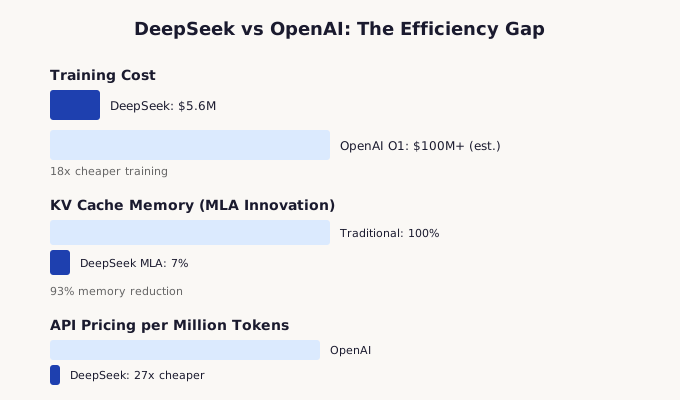
NVIDIA lost $600 billion in a single day. Not from a product failure or executive scandal, but from a research paper published by a 200-person Chinese startup most Americans had never heard of. DeepSeek’s R1 model matched OpenAI’s frontier capabilities on key benchmarks—reportedly trained for just $5.6 million compared to OpenAI’s estimated $100 million-plus.
Marc Andreessen called it “AI’s Sputnik moment.” But the real story isn’t about one company. It’s about what happens when you try to cap a nation’s compute access and they respond by rewriting the rules of efficiency.
The GPU-Poor Paradigm: When Constraints Spark Innovation
The timeline matters here. In October 2022, the United States imposed additional controls restricting advanced chips and chip-making equipment to China, building on earlier 2018 sanctions. The intent was explicit: cap China’s ability to train frontier-scale AI models.
But buried in this news were three facts that changed everything.
First, knowing sanctions were coming, Chinese companies stockpiled NVIDIA A100 GPUs. Not the most powerful available, but powerful enough.
Second, the 2022 sanctions didn’t ban all AI GPUs. The H800s and A800s had restricted memory connectivity, but they retained raw compute capability.
Third, when loopholes closed a year later, the cat was already out of the bag.
“The bottom line? Three innovations. One thesis. You don’t need the most compute. You start with the smartest architecture.”
DeepSeek’s innovations attacked the two biggest constraints in AI: memory and compute.
Their Multi-Headed Latent Attention compressed the massive key-value matrices that traditional transformer architectures require. Think of it as zipping a file before using it and unzipping only when needed. The result: 93% reduction in memory requirements with nearly 6x faster inference. That’s why DeepSeek offered API pricing 27 times cheaper than OpenAI.
Their Mixture of Experts architecture distributed 675 billion parameters across 256 specialized networks—but for any given query, only 37 billion were active, routed to just eight relevant experts. Think of it like a hospital: you don’t need every specialist for a broken arm. You get routed to orthopedics.
But the innovation that truly spooked Western researchers was pure reinforcement learning. Traditional AI training requires millions of human-labeled examples—expensive, slow, limited by human effort. DeepSeek tried something radical: what if you just tell the model to get the right answer and let it figure out how?
They gave the model math problems with a single reward signal: correct or incorrect. No step-by-step demonstrations. No human-written reasoning chains.
Over subsequent iterations, something remarkable emerged. The model spontaneously developed self-verification—pausing to validate its work, breaking problems into steps, allocating more thinking time for harder problems. DeepSeek’s paper describes “witnessing the raw power and beauty of reinforcement learning.”
On the AIME benchmark, accuracy jumped from 15.6% to 71%, matching OpenAI’s models.
Open Source as Strategic Weapon
One might think DeepSeek was a lone wolf. The truth is the opposite.
Alibaba calls its Qwen series “the Llama of the East”—and it’s not just marketing. It’s a business model declaration. Meta gives away Llama to commoditize the model layer and keep developers on Meta’s infrastructure. Alibaba does the same with Alibaba Cloud.
The Qwen family spans 0.5 billion to 72 billion parameters—deployable from edge devices to cloud servers. Qwen 3.4 with 32 billion parameters rivals GPT-4 on HumanEval, the most stringent coding benchmark.
Why coding? This is strategic, not accidental. Developers who use Qwen Coder get locked into Alibaba’s ecosystem. Same play GitHub made with Copilot. Own the developer, own the future. If 10 million developers use Qwen Coder worldwide, that’s 10 million potential Alibaba Cloud customers.
“China chose open as a strategic wedge against Western competitors. Because they cannot compete with OpenAI’s closed API model, they’re undercutting and commoditizing the foundation layer.”
The data backs this up. According to Stanford HAI, Qwen has now surpassed Meta’s Llama in cumulative downloads. Alibaba is beating Meta at their own open-source game—the game Meta pioneered. DeepSeek’s trajectory is nearly vertical starting mid-2025.
Zero One AI tells a parallel story. Founded by Kai-Fu Lee—who built Microsoft Research China and led Google China—the company name in Mandarin means “zero to one produces all things.” They raised $300 million from Alibaba, Tencent, and Xiaomi, becoming a unicorn in eight months.
When DeepSeek collapsed API margins overnight, Zero One AI pivoted instantly. Their pre-training teams disbanded. They shifted from model-first to application-first, using model distillation—training smaller specialized models from giant open ones like DeepSeek. They stopped obsessing about benchmark scores and started obsessing about revenue versus inference cost.
Look at the Chatbot Arena leaderboard today. The top 10 is dominated by Chinese labs: Z.ai, Moonshot, Alibaba, DeepSeek. GLM 4.6 holds the number one spot. There’s only one US model in the top 25.
The Sovereign Compute Stack
China isn’t just building models. They’re building an entire parallel infrastructure.
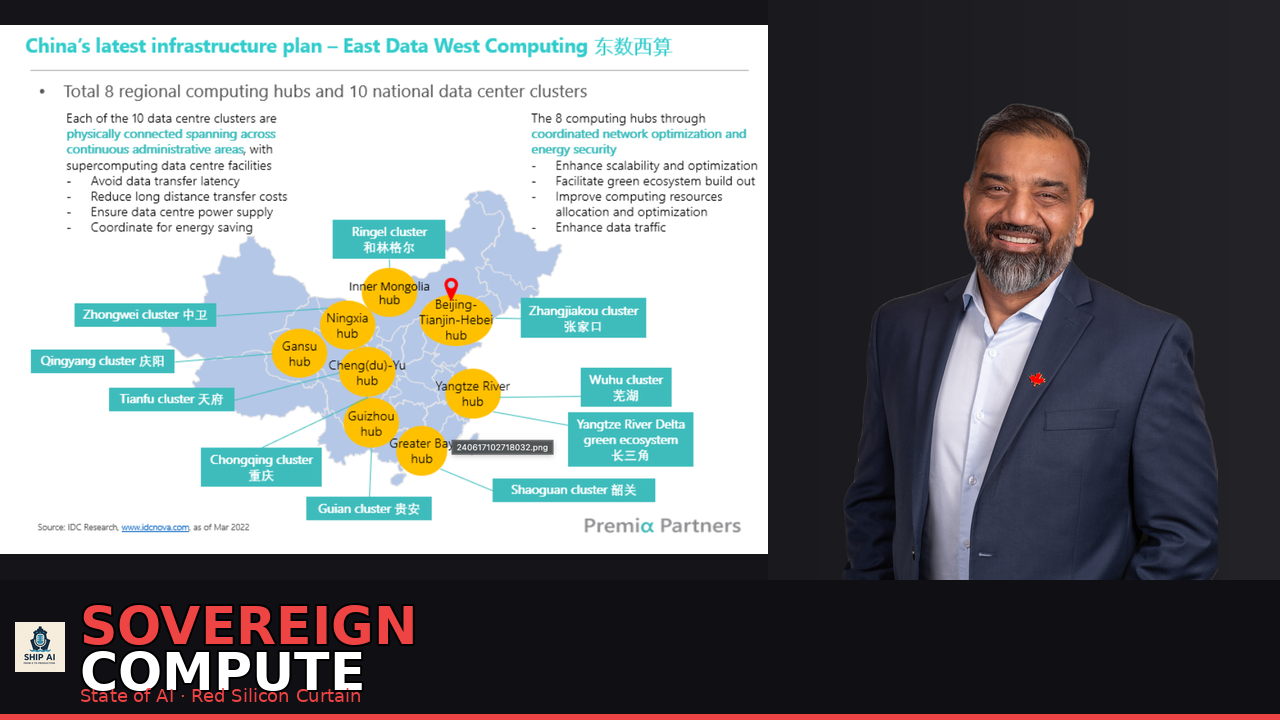
The “East Data, West Computing” initiative solves a fundamental problem. Eastern provinces—Beijing, Shanghai, Shenzhen—have high populations, high energy costs, and 70% of data center power comes from coal. Western provinces—Guizhou, Inner Mongolia, Gansu—have massive solar and wind capacity. Electricity is 50% cheaper with natural cooling advantages.
The solution: train models in the west where energy is cheap, serve inference in the east where consumers are. Lower latency, lower costs, cleaner energy.

Big Fund 3 represents China’s largest bet on semiconductor self-sufficiency: $47.5 billion—more than the US CHIPS Act. The thesis: compress 30 years of semiconductor evolution into five years. For the first time, they’re targeting equipment and materials—the exact chokepoints where US export controls hit hardest. The 15-year duration signals patient capital. They know what they’re up against.
C2Net ties it together as a national computing grid treating AI compute as a public utility. Eight hubs, 280 exaflops capacity, 30% year-on-year growth.
The domestic chip stack is emerging. Cloud Brain evolved from NVIDIA GPUs to Huawei’s Ascend platform. The Ascend 910C runs at about 65% of NVIDIA’s H100—not parity, but workable. Most analysts put China 24 months behind the US, but 2025 showed they may not be that far.
Atoms Over Bits: The Humanoid Robot Bet
While everyone obsesses over AI models, China is betting on physical deployment.
The philosophical divergence is stark. US companies like Tesla’s Optimus and Figure AI prioritize generalized intelligence—build once, handle any task. Some argue they’re waiting for AGI before mass deployment. Chinese companies like UBTech and Unitree are deploying good-enough robots now.
Unitree prices at $16,000 compared to Western robots starting at $90,000. One analyst called it “the iPhone moment for humanoid robotics.”
UBTech’s Walker S achieved the first mass factory deployment—21 consecutive days of cargo packing at a Zeekr facility. This isn’t a demo. This is deployment.
JD.com runs dark warehouses with 99.99% packing efficiency, 24/7 completely unmanned. That infrastructure makes two-hour shipping possible.
The implications ripple globally. Emerging markets—Southeast Asia, Latin America, Middle East—will become the battleground. Good enough at a fraction of the cost is China’s playbook.
What Enterprise Leaders Must Decide Now
Five questions every CTO must ask:
Should you have a China contingency in your AI strategy? What do you do when your developers start using Qwen—blacklist Chinese models just because of origin? What if they’re more efficient for your use case?
What about hardware dependence? Are you too reliant on a single chip architecture?
The efficiency-versus-capability question cuts deep. Frontier models might be more capable, but for customer acquisition, fraud detection, loss prevention—do you need maximum capability, or do you need cost-effective deployment?
The uncomfortable truth: these two stacks are becoming hardware incompatible. Code that runs on CUDA won’t run on Ascend without significant work.
The irony is thick. Export controls may have slowed China’s scaling, but they accelerated efficiency innovation. DeepSeek exists because of chip restrictions.
This episode is part of our State of AI series. In upcoming episodes, we’ll examine how the GPU wars are reshaping data center economics and what the bifurcating tech stacks mean for global supply chains. If the efficiency revolution interests you, don’t miss our deep dive on inference optimization strategies coming next.
Related Episodes
Dive deeper into these topics in the podcast.
The Red Silicon Curtain
Sanctions didn't kill Chinese AI — they mutated it into something more formidable: a leaner, inference-optimized, vertically-integrated competitor.
Enjoying this article?
Ship AI is a video podcast covering the trends, tools, and strategies driving enterprise AI. New episodes every two weeks.