AI's $212 Billion Bet: Following the Money Behind the Hype
Table of Contents
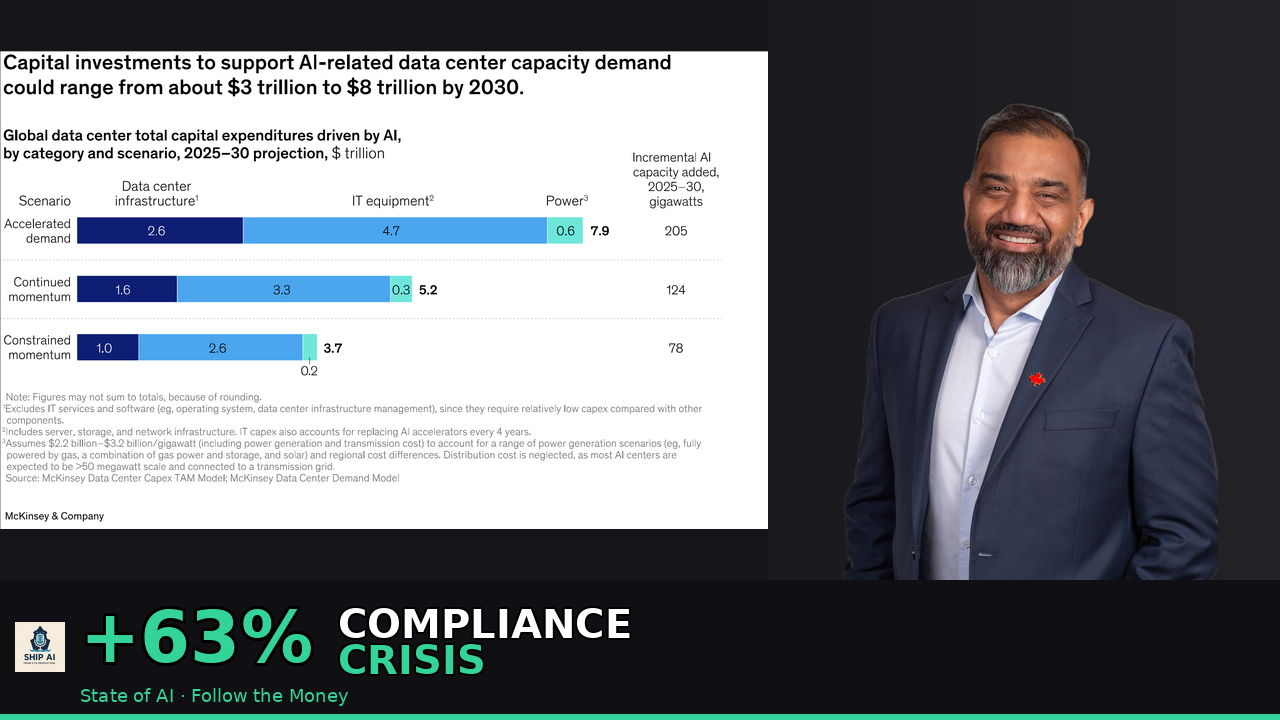
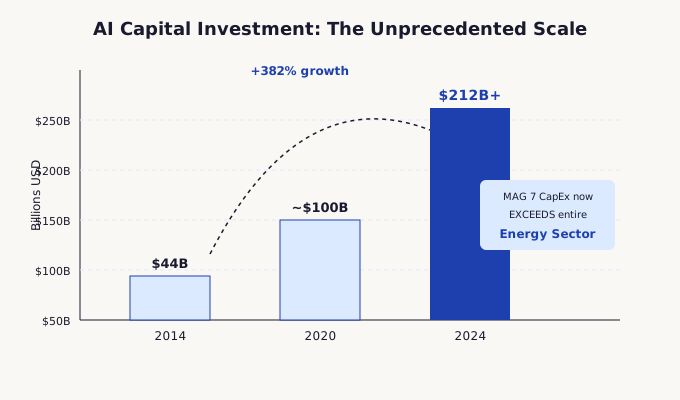
Seven companies are now spending more on AI infrastructure than the entire global energy sector. In 2014, the largest technology companies spent about $44 billion a year on capital investments. By 2024, that number passed well over $200 billion—and almost all of the increase had one name attached to it: AI.
This isn’t incremental spending. This is the largest concentrated investment of capital in corporate history. The Magnificent Seven are pouring money into chips, data centers, custom silicon, even nuclear plants. And this is before the business models are proven, before margins stabilize, and before regulators catch up.
Here’s the uncomfortable question no one likes to ask: What if it doesn’t pay off?
The Industrial-Scale Reallocation of Capital
Look at the US macro-level data: AI-related investments in computers, communications equipment, and semiconductors far outpace everything else since 2020. The energy sector has barely grown. The rest of the non-energy economy remains largely flat.
This is not a normal tech cycle. This is industrial-scale reallocation of capital. AI is no longer riding on top of the economy—it’s the fastest growing sector inside it.
The Magnificent Seven—Amazon, Apple, Google, NVIDIA, Meta, Microsoft, and Tesla—saw 63% year-on-year growth in capital investment in 2024 alone. Fifteen percent of their revenues now go toward capital expenditure. This is infrastructure spending at a scale we haven’t seen since the mainframe era from IBM in 1969.
“The Magnificent Seven’s CapEx plus R&D has grown 6x—not 6%, not 60%—6x since 2020. The rest of large-cap companies? Essentially flat.”
Here’s the critical insight: AI progress is now being decided by who can spend. These companies are building economic moats around their models—through data centers, energy acquisition, data, and GPUs—not just through innovation.
NVIDIA’s data center revenues as a share of market-wide capital spending are approaching 15%. That’s at the same level as IBM’s peak revenues in 1969 and the combination of Cisco, Lucent, and Nortel at their peak in 2000.
The Circular Economy of AI Investment
Where does the money go? Across 2024, total capital exceeded $200 billion. Half goes directly to GPUs and specialized chips. And here’s the critical imbalance: companies spend 2.25 times more on training models than running them.
Training is a one-time cost. Inference is what scales with revenue. For AI to become sustainable and profitable, this ratio has to flip.
But the real story is the circular flow of capital between these giants. Let me walk you through it:
Microsoft invested $13.5 billion in OpenAI for a 27-30% stake. OpenAI then uses 80% of that investment on Microsoft Azure Cloud. So Microsoft invests billions, gets revenue back as cloud business, and watches their investment appreciate as OpenAI’s valuation rises.
NVIDIA announced a $100 billion commitment to OpenAI in September 2025. In return, OpenAI agreed to deploy 10 gigawatts worth of NVIDIA chips. Capital goes in, revenue comes out.
Then comes Project Stargate—a $500 billion commitment announced at the White House. OpenAI signed a $300 billion deal with Oracle for cloud infrastructure. Oracle committed $40 billion to NVIDIA GPUs for their Texas data center. The triangle closes: money flows to Oracle, flows to OpenAI, back to NVIDIA.
“Everyone’s buying equity into their own customers. This is the circular economy of AI.”
Even NVIDIA competitors are joining. AMD offered OpenAI warrants for 160 million shares at one cent per share in exchange for a six-gigawatt GPU deployment commitment. AMD expects $100 billion in revenue over four years. When the deal was announced, AMD stock jumped 35%, adding $80 billion to market cap.
At the heart of it all: eight or nine companies control the entire AI ecosystem. And there’s concentration risk. 53% of NVIDIA’s data center revenue comes from just three mystery clients they don’t disclose. Two customers are responsible for 39% of their quarterly revenue. If any one stumbles, the world’s most valuable company is in trouble.
The Revenue Velocity Nobody Expected
The fastest revenue ramp in software history happened in the last three years. OpenAI grew 65 times in three years—from approximately $200 million ARR in 2023 to projected $13 billion by August 2025. Anthropic grew 80 times, from $87 million to a projected $7 billion.
For comparison: Salesforce took 10+ years to reach $10 billion in ARR. AI companies are hitting that in about 36 months.
The downstream startups show similar patterns. OpenAI invested $5 million in Harvey AI in 2022—it’s now valued at $2 billion. They put $8 million into AnySphere (the company behind Cursor)—it’s now worth $29 billion market cap. And all of them are using OpenAI’s APIs, creating yet another circular revenue loop.
The Hidden Costs Squeezing AI Economics
For every dollar spent on NVIDIA chips, companies are spending 80 cents on talent. Entry-level data scientists command $300-500K. The best ML engineers at top firms get $800K. Top AI researchers have been offered multi-hundred-million-dollar bonuses.
But there are two new taxes that weren’t accounted for historically.
The Data Tax: Prior to GPT-3, the model was scrape everything, pay nothing. Now they have to license everything and pay perpetually. Reddit entered a $130 million annual deal with Google and OpenAI. The annual estimated cost for data is now over $800 million a year. Training on free internet data is over. New entrants can’t afford the high-quality web—this creates an incumbency moat for the dominant players.
The Compliance Tax: As regulation catches up, regulatory costs exceed hardware costs for many enterprise AI deployments. EU AI Act implementation runs $5-10 million minimum. US state patchwork regulations cost $2-5 million per state. GDPR compliance adds another $3-7 million annually. Total compliance burden: an additional 25% on AI budgets.
Then there’s safety research. Anthropic spends 30% of their budget on model safety and alignment. OpenAI spends 25%. DeepMind spends 20%. That’s $15 billion a year at the model training level alone—before enterprises add their own safety layers.

The Margin Crisis and AI Cost Paradox
The world is moving from traditional SaaS—which enjoyed 80-90% gross margins—to what I call AI supernovas: venture capital subsidized offerings with only 25% gross margins.
Traditional SaaS sold access to a tool on a per-seat, per-month license. The transition now is to service-as-software, where enterprises want outcomes, not seat licenses. They want an AI agent for HR that shifts costs around their operations—on an outcome basis, per resolution.
Every query now has two costs: compute and tokens. When agents get involved, token consumption explodes—sometimes 10 times, maybe even 100 times, depending on task complexity.
GitHub Copilot famously lost $20 per user in early 2023. Replit had sub-10% gross margin at peak. If AI companies continue having lower margins than SaaS, Wall Street will reward them with lower multiples.
And then there’s the AI cost paradox: building frontier models is exponentially more expensive, but selling access is getting cheaper. The largest training runs will cost more than a billion dollars by 2027. Which means frontier models of tomorrow will be too expensive for anyone except the Magnificent Seven.
“For AI to profit, the training-to-inference cost ratio has to flip. Training is a one-time investment. Inference scales with revenue.”
DeepSeek demonstrated this tension perfectly. On January 27, 2025, NVIDIA lost nearly $600 billion in market cap—the largest single-day drop in US market history—triggered by a Chinese AI company most people hadn’t heard of. DeepSeek released an open-source reasoning model matching OpenAI’s frontier capabilities at a fraction of the cost, with architectural breakthroughs that slashed memory requirements by 93%.
Mark Andreessen called it AI’s Sputnik moment. The comparison is apt—like how the Soviet Union shocked America in 1957, DeepSeek demonstrated Chinese capabilities had far exceeded Western expectations.
What Has to Be True for This to Work
The projected total addressable market for generative AI is $4 trillion—about 15% of US GDP, roughly the entire German GDP. Morgan Stanley breaks it down: $1.3 trillion in software and IT, $1.1 trillion in professional services, with customer operations, R&D, and supply chain making up the rest.
The key assumptions: enterprises get 15-20% productivity gains, 50% of global tasks are augmentable through AI, and enterprises achieve organization-wide adoption.
Early signals suggest these aren’t crazy assumptions. AI-assisted coding studies from Microsoft, GitHub, and PayPal report 30-55% efficiency gains. PayPal’s CEO is on record that their developers were 30% more productive.
But 70% of AI projects fail to deliver promised ROI, according to MIT. The hidden costs—implementation, integration, data preparation, ongoing tuning—eat into the business case.
When capital moves this fast and this aggressively, it’s not about optimism. It’s about pressure. And pressure always reveals the real story.
For more on how AI infrastructure is reshaping the physical world, check out our episodes on the energy crisis facing AI and the new silicon race challenging NVIDIA’s dominance.
Related Episodes
Dive deeper into these topics in the podcast.

Follow the Money
In 2014, the largest tech companies spent $44 billion on capital investments. By 2024, that number passed $200 billion — almost all of it tied to AI.
Enjoying this article?
Ship AI is a video podcast covering the trends, tools, and strategies driving enterprise AI. New episodes every two weeks.