AI's Hidden Costs: Margin Crisis & Cost Paradox
Table of Contents
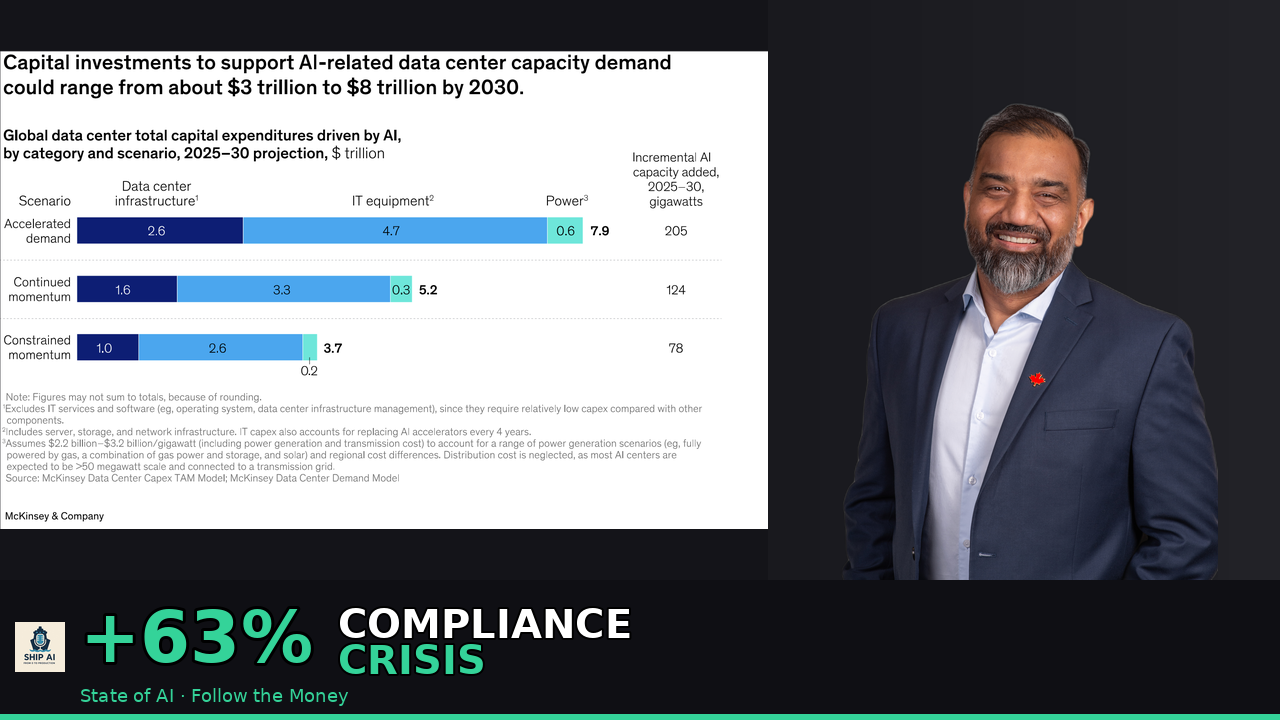
I’ve been digging into the capital expenditure numbers behind the AI boom, and one stat keeps stopping me cold: $212 billion. That’s what the Magnificent Seven spent on AI infrastructure in a single year.
To put that in perspective, these seven companies—Amazon, Apple, Google, Meta, Microsoft, NVIDIA, and Tesla—are now spending more on AI infrastructure than the entire global energy sector spends on capital investment.
The spending that doesn’t add up yet
Here’s what the numbers actually look like: 63% year-on-year growth in capital investment in 2024. 15% of revenues going directly to CapEx. And when you look at CapEx plus R&D combined, the Magnificent Seven have grown 6x since 2020—not 6%, not 60%, but six times—while the rest of the large-cap market has remained essentially flat.
The JP Morgan data is stark. There’s a clear divergence happening where a handful of companies are making a coordinated bet that the rest of the market hasn’t joined.
“This is infrastructure spending at a scale we have not seen since the mainframe era from IBM in 1969.”
And here’s the uncomfortable parallel: NVIDIA’s data center revenues as a share of market-wide capital spending are now approaching 15%. That’s exactly where IBM peaked in 1969, and where Cisco, Lucent, and Nortel peaked in 2000. Both of those moments preceded significant corrections.
The margin crisis hiding in plain sight
When you break down where the $212 billion actually goes, the picture gets more concerning.
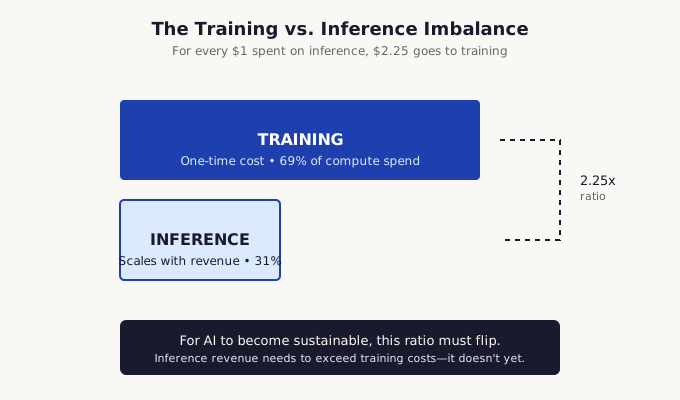
Half of that money goes directly to GPUs and specialized chips. But here’s the critical imbalance: companies are spending 2.25x more on training models than on running them.
Training is a one-time cost. Inference is what scales with revenue. For AI to become sustainable and profitable, this ratio has to flip—and right now, it hasn’t.
The revenue velocity is real—OpenAI grew 65x in three years, Anthropic 80x. These are the fastest revenue ramps in software history. But revenue isn’t margin. And margin is what determines whether this spending was an investment or a write-off.
The capital loop that keeps it spinning
What makes this cycle particularly fascinating is how the money moves in closed loops between the same players.
Microsoft invests $13.5 billion into OpenAI. OpenAI then spends 80% of its compute budget on Microsoft Azure. Microsoft gets the money back as cloud revenue while its equity stake appreciates.
NVIDIA commits $100 billion to OpenAI. In return, OpenAI agrees to deploy 10 gigawatts of NVIDIA chips in their data centers. Capital goes in, revenue comes out.
Then Oracle joins with Project Stargate—$500 billion committed over four years, the largest AI infrastructure project ever announced. Oracle signs a $300 billion deal with OpenAI for cloud infrastructure, then commits $40 billion to NVIDIA for 400,000 GPUs.
“The money flows to Oracle, money flows to OpenAI, flows to Oracle back to NVIDIA. That’s the third loop in there.”
This isn’t a market in the traditional sense. It’s a closed system where a handful of players are funding each other’s growth. That can work—until it doesn’t.
The uncomfortable question remains: what if it doesn’t pay off? When capital moves this fast and this aggressively, it’s not about optimism. It’s about pressure. And pressure always reveals the real story.
This analysis is from Episode 2: Follow the Money, where I break down the full picture of AI capital flows—from the Magnificent Seven’s spending to why the DeepSeek shock knocked $600 billion off NVIDIA in a single day.
Related Episodes
Dive deeper into these topics in the podcast.

Follow the Money
In 2014, the largest tech companies spent $44 billion on capital investments. By 2024, that number passed $200 billion — almost all of it tied to AI.
Enjoying this article?
Ship AI is a video podcast covering the trends, tools, and strategies driving enterprise AI. New episodes every two weeks.