AI's Hidden Costs: Compliance & Safety
Table of Contents
I’ve been tracking AI infrastructure spending for a while now, but even I wasn’t prepared for what the 2024 numbers revealed.
The Magnificent Seven—Amazon, Apple, Google, Meta, Microsoft, Nvidia, and Tesla—grew their capital expenditure by 63% year-over-year in 2024. That’s not a typo. Sixty-three percent in a single year.
But here’s what that number doesn’t tell you: a massive chunk of that spending isn’t going toward making AI better. It’s going toward making AI acceptable.
The Hidden Tax on AI Progress
When you dig into where these billions actually flow, you start seeing line items that never made the headlines. Compliance teams. Safety research. Model evaluation infrastructure. Red-teaming operations.
These aren’t optional extras. They’re becoming the cost of doing business.
Think about what it takes to ship an AI product in 2025. You need compute for training—that’s the obvious part. But you also need compute for safety testing. You need teams to evaluate outputs across thousands of edge cases. You need legal review for every new capability. You need documentation systems that can prove to regulators you did your due diligence.
“When capital moves this fast and this aggressively, it’s not about optimism. It’s about pressure, and pressure always reveals the real story.”
The pressure isn’t just competitive anymore. It’s regulatory, reputational, and existential.
Where the Money Actually Goes
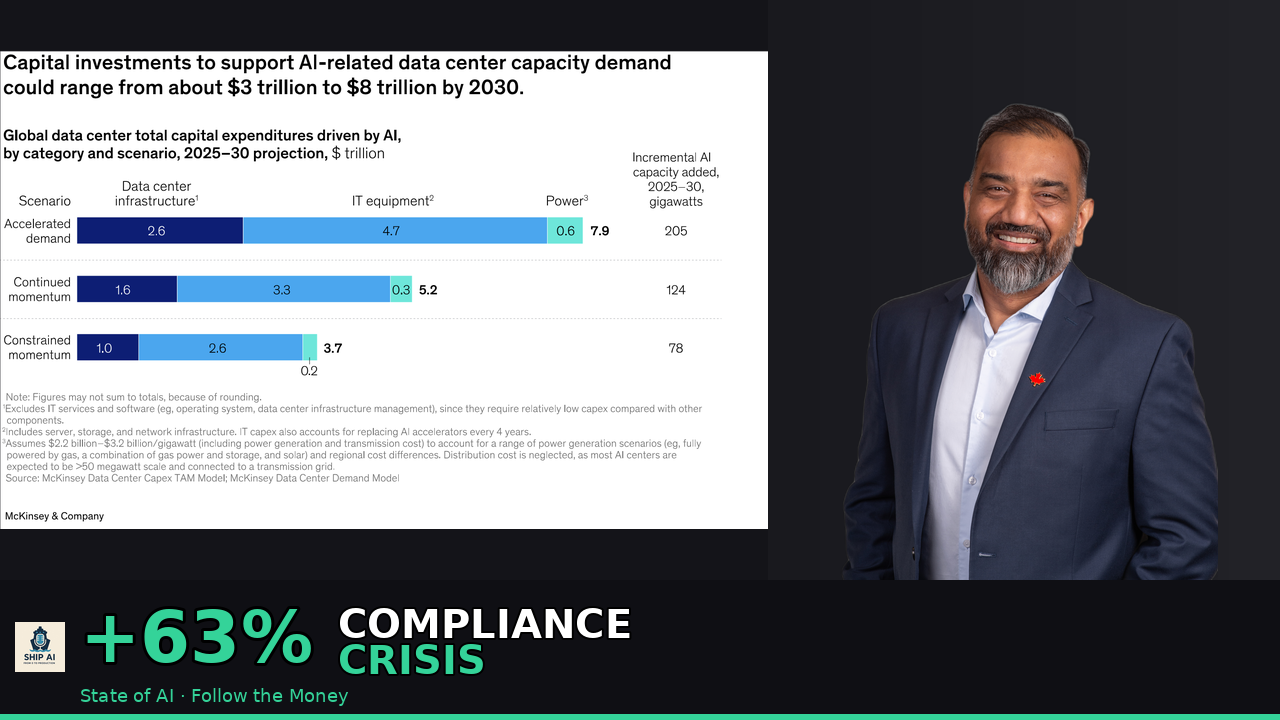
Here’s a view that puts this in perspective:

The compliance and safety bucket might look small at 8%, but it’s growing faster than any other category. And unlike GPUs, it doesn’t generate direct revenue. It’s pure overhead—the price of being allowed to operate.
The Ratio That Has to Flip
What struck me from the data: companies spend 2.25 times more on training models than on running them.
Training is a one-time cost. Inference is what scales with revenue. For AI to become sustainable, that ratio needs to invert. But safety requirements apply to both ends. You can’t just evaluate a model once and ship it. You need continuous monitoring, ongoing red-teaming, regular compliance audits.
“15% of their revenues are going towards capital expenditure. This is infrastructure spending at a scale we have not seen since the mainframe era.”
IBM in 1969 didn’t have to worry about their mainframe generating harmful content. Cisco in 2000 didn’t need teams evaluating whether their routers might be misused. AI companies face a fundamentally different challenge: the thing they’re building is unpredictable by design.
What This Means for Shipping
If you’re building AI products today, these hidden costs hit you whether you’re a startup or one of the Magnificent Seven. The regulatory environment is tightening. User expectations around safety are rising. And the reputational cost of getting it wrong—one bad headline, one viral failure—can undo years of work.
The companies winning aren’t just the ones with the best models. They’re the ones who’ve built compliance and safety into their DNA from day one, rather than bolting it on later.
That 63% year-over-year growth in spending? A growing portion of it is essentially a tax on being in the AI business at all.
This is a clip from Ship AI Episode 2, “Follow the Money.” For the complete breakdown of where AI capital is flowing and what has to be true for this multi-trillion dollar bet to pay off, listen to the full episode.
Related Episodes
Dive deeper into these topics in the podcast.

Follow the Money
In 2014, the largest tech companies spent $44 billion on capital investments. By 2024, that number passed $200 billion — almost all of it tied to AI.
Enjoying this article?
Ship AI is a video podcast covering the trends, tools, and strategies driving enterprise AI. New episodes every two weeks.