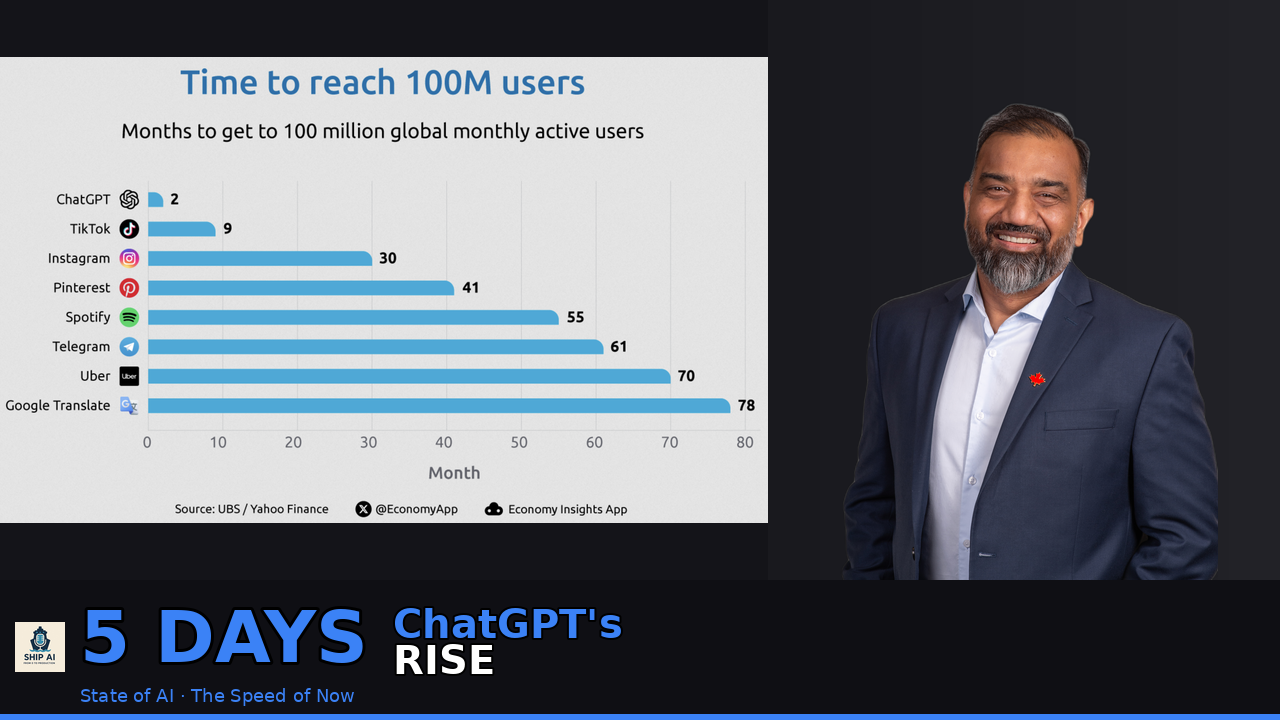
ChatGPT Hit 1 Million Users in 5 Days. Here's What Actually Happened.
Table of Contents
ChatGPT hit 365 billion searches in under two years. Google took 11 years to get there. This isn’t evolution—it’s a different species altogether.
I’m sure like me, many of you are overwhelmed with the rate and pace of innovation within AI. It almost feels like everything is happening all at once. So let me try to break down what’s really going on.
The Three Curves That Collided
In the last two years, something unusual has happened. Not a breakthrough necessarily by itself, not just a new product, but really a change in speed. Technological change has always been fast, but what we’re seeing now is different. It just feels different.
Things that used to mature in decades or years are now happening in months or weeks. Entire categories of work—from writing to coding to analysis to design—have gone from human-only to human-augmented almost overnight.
Here’s the important part: this didn’t happen because AI suddenly became intelligent. It happened because three curves collided at the same time.
- Compute became ubiquitous—became abundant
- Algorithms became more efficient
- Data reached critical mass
When these three curves crossed, progress stopped being gradual and became abrupt. This is why AI feels like it arrived all at once.
“The real story of this moment is not about chatbots, it’s not about AI agents, it’s not about demos or viral screenshots. It’s about what happens next. Because once technology reaches this level of capability, the limiting factor is not what it can do—it’s how fast institutions, companies, organizations, governments, and people can adapt to it.”
The Numbers That Broke Every Playbook
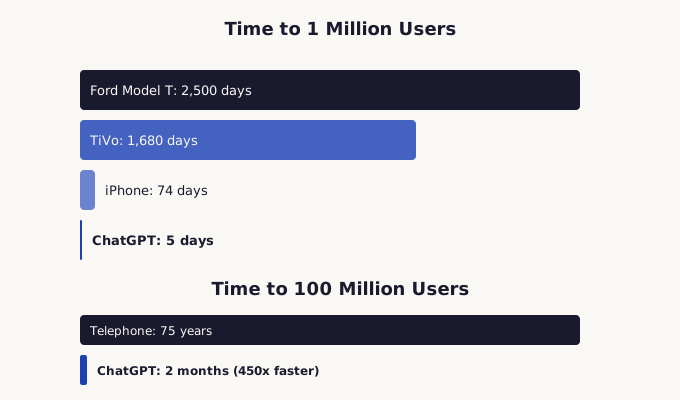
Let me put this in perspective. It took Ford Model T 2,500 days to get to 1 million users. The iPhone—which spawned the entire app store industry we know today—took 74 days. With little to no marketing, ChatGPT took five days. That’s 500 times faster.
And it’s not a flash in the pan. ChatGPT now has 800 million weekly active users—an increase of eight times in 17 months. The retention rate is 80%, compared to 58% for Google searches. People who try it keep using it.
The telephone—really the first technology that transformed how humans connect—took 75 years to reach 100 million users. ChatGPT did it in two months.
“If you’re not exposed to tech, if technology is not the centerpiece of your business strategy, you are structurally underweighting the economy.”
The top seven companies—Apple, Amazon, Meta, Google, Microsoft, Tesla, and NVIDIA—represent 40% of U.S. market capitalization. They account for 25% of the entire global market.
Why 2012 Changed Everything
AI is 70 years in the making. The term “artificial intelligence” was coined in 1956. We had a checkers-playing program that could self-learn in 1952. We went through AI winters in 1974 and 1984 where everyone thought the technology couldn’t deliver.
But there’s one moment that truly explains why deep learning exploded and why NVIDIA became what it is today: AlexNet in 2012.
Before AlexNet, image recognition error rates were 25-28%. AlexNet used GPUs from NVIDIA combined with deep neural networks, and the error rate dropped to 16.4%. That 10% gap proved that both the technology and this new form of compute matter. By 2015, AI was actually better than humans at image recognition—around 5% error rate.
The previous neural networks were one to two layers deep. AlexNet was eight layers. The combination of depth plus compute provided the breakthrough.
The Four Enablers That Killed Geographic Lag
There used to be a point where technologies had to be localized. Amazon had to create Amazon for India. Google had to build local entities with local data in local languages. That playbook is dead.
Four enablers made ChatGPT’s global explosion possible:
Elastic cloud infrastructure: In 2006, Amazon created EC2, then rebranded as AWS in 2008. Two people in a Starbucks can now access the same compute power as the biggest companies in the world. Microsoft Azure and GCP with TPUs are akin to the largest supercomputers with thousands of H100 GPUs.
API-based access: Every LLM call is just one API call away. You can integrate into Bing, Notion, Canva—thousands of applications created in weeks.
Zero-friction access: Unlike the iPhone where you install an app, ChatGPT is web-first. All you need is a browser. No download, no setup, just a text box. Time to value is zero.
Natural language interface: There’s no syntax to learn. You just talk to it like a human. The learning curve is eliminated entirely.
Asia alone is now the largest consumer of ChatGPT. The split between urban and rural is healthy. You have widespread adoption across the US, Brazil, Germany, France, Australia, Nigeria, South Africa. This is ubiquitous.
“The old playbook of local arbitrage no longer exists. Everybody gets the same AI on day one. Scale matters less than speed. The only way to win is to iterate faster.”
The Cambrian Explosion in Nine Years
At the time I recorded this, Hugging Face had over two million models and just under 700,000 datasets. At one point around October or November 2025, they were getting 100,000 new models per month. That’s real exponential adoption.
The progression went like this: 2017-2020 was the research era where foundations were laid. OpenAI developed GPT-3 with 175 billion parameters, proving scaling laws could work. 2021 onwards became the scaling era—bigger is better, the world was obsessed with the largest model anyone could build.
ChatGPT launched in November 2022. AI went mainstream. 100 million users in two months. The best benchmark score at that point was 74.1—inching near human performance at 89%.
Then came 2023. GPT-4 beat human performance for the first time. Multimodal AI arrived—you could generate images, videos, paste an image and ask for interpretation. Meta open-sourced Llama 2, and open-source truly began to catch up. Anthropic’s Claude 3 was the first to meet and beat GPT-4 on multiple benchmarks.
From 2025 onwards, we entered what I call the weekly release era. DeepSeek R1 came out with reasoning models that could recognize their own errors—researchers call this the “aha moment”—then retrace steps and correct themselves.
What This Actually Means for You
Here’s what I want you to take away: benchmark performance doesn’t mean real-world intelligence. AI researchers engineer models to perform well on benchmarks because that’s how they’re measured. The tests are structured. This doesn’t mean AI thinks like humans.
Just because AI excels on a benchmark doesn’t mean it’ll have human-like performance in practice—it will hallucinate. And benchmarks age as models get better, so researchers keep introducing new ones like “Humanities Last Benchmark” where the top system scores only 8%.
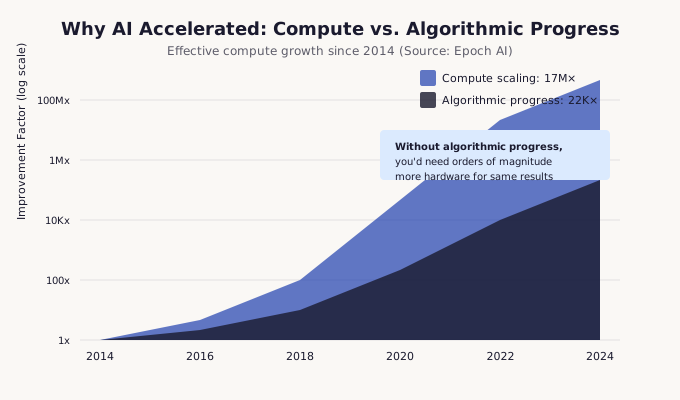
The real story about AI progress is not just about compute. It’s about better algorithms, better training, and better use of resources. The next wave of breakthroughs will come not from who has the biggest GPUs, but who can use infrastructure more cleverly.
Once AI hits parity with humans on any task, it improves faster than humans ever could. It takes a long time to reach a certain benchmark—but once there, through improvements in data curation or algorithms, these systems learn faster than we can.
Want to understand the capital and infrastructure forces reshaping AI? Check out our episodes on NVIDIA’s rise and the economics of training frontier models.
Related Episodes
Dive deeper into these topics in the podcast.

The Speed of Now
The conversation delves into the exponential growth of AI models, the impact of compute abundance, global adoption of AI, and the comparison of AI performance with human capability.
Enjoying this article?
Ship AI is a video podcast covering the trends, tools, and strategies driving enterprise AI. New episodes every two weeks.