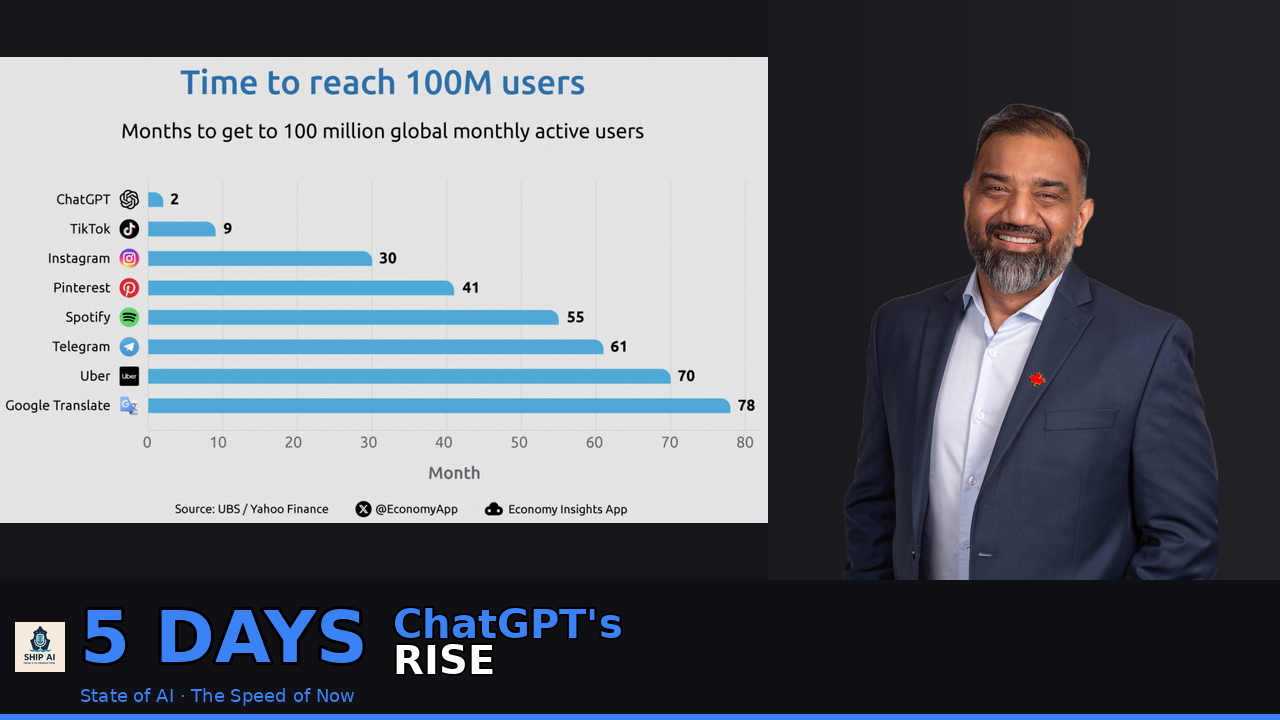
Chat GPT's Meteoric Rise
Table of Contents
Five Days to a Million Users: The Speed That Changed Everything
When I first saw the numbers on ChatGPT’s adoption, I had to triple-check them. Not because they seemed wrong, but because they broke every mental model I had about how technology spreads.
Five days to one million users.
To understand why that number matters, you have to see it against the backdrop of every major technology that came before.
The 500x Acceleration
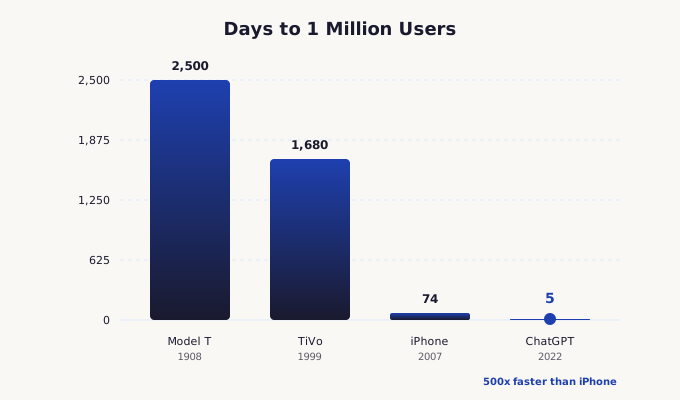
The Ford Model T—the product that literally invented modern manufacturing—took 2,500 days to reach one million users. The iPhone, which spawned an entire app economy and changed how humans interact with computers, took 74 days.
ChatGPT did it in five. That’s 500 times faster than the iPhone.
“With little to really no marketing, ChatGPT took five days. 500 times faster than the Model T. The infrastructure and distribution channels that exist today made this possible.”
But here’s where it gets more interesting. Getting to a million users quickly could be a flash in the pan—a viral moment that burns out. The real test is scaling to 100 million users.
The telephone took 75 years to hit that milestone. ChatGPT did it in two months. That’s 450 times faster than the technology that first connected humans across distances.
This Isn’t a Spike—It’s a New Baseline
What convinced me this wasn’t just viral hype was the retention data. ChatGPT now has 800 million weekly active users—an 8x increase in just 17 months. But the number that really caught my attention was the retention rate: 80%, compared to 58% for Google searches.
That means people who try it don’t just come back—they come back more reliably than they return to the search engine that’s been their default for two decades.
“People who try it keep trying it, keep using it.”
This isn’t adoption. This is behavioral shift happening in real-time.
Why the Speed Matters More Than the Capability
Here’s what I keep coming back to: AI didn’t suddenly become intelligent in late 2022. What happened is three curves collided at the same time—compute became abundant, algorithms became efficient, and data reached critical mass.
When those curves crossed, progress stopped being gradual. It became abrupt.
But the real implication isn’t about AI capability. It’s about adaptation speed. Once technology reaches this level of capability, the limiting factor isn’t what it can do—it’s how fast companies, institutions, and people can adapt to it.
Five days to a million users means the window to adapt just got a lot shorter. The organizations that figured out how to use ChatGPT in month one had a 17-month head start on the ones still running pilots today.
That gap compounds.
This clip is from Episode 1 of Ship AI, “The Speed of Now.” Listen to the full episode for more on the forces reshaping AI in 2025.
Related Episodes
Dive deeper into these topics in the podcast.

The Speed of Now
The conversation delves into the exponential growth of AI models, the impact of compute abundance, global adoption of AI, and the comparison of AI performance with human capability.
Enjoying this article?
Ship AI is a video podcast covering the trends, tools, and strategies driving enterprise AI. New episodes every two weeks.